- Hans Weber
- February 26, 2026
An Iran Without the Mullah Regime: Desirable – but Strategically Calculated
By Hans Weber
An Iran without the mullah regime would represent liberation for many Iranians. This is not a provocative thesis, but a sober assessment when one considers four decades of repression, executions, enforced religiosity, the power of the Revolutionary Guards, economic stagnation under sanctions, systemic corruption, and the violent suppression of protests.
The question is simply this: Is the liberation of the Iranian people the real reason behind the current military escalation? Historically as well as in the present, the answer is usually: no.
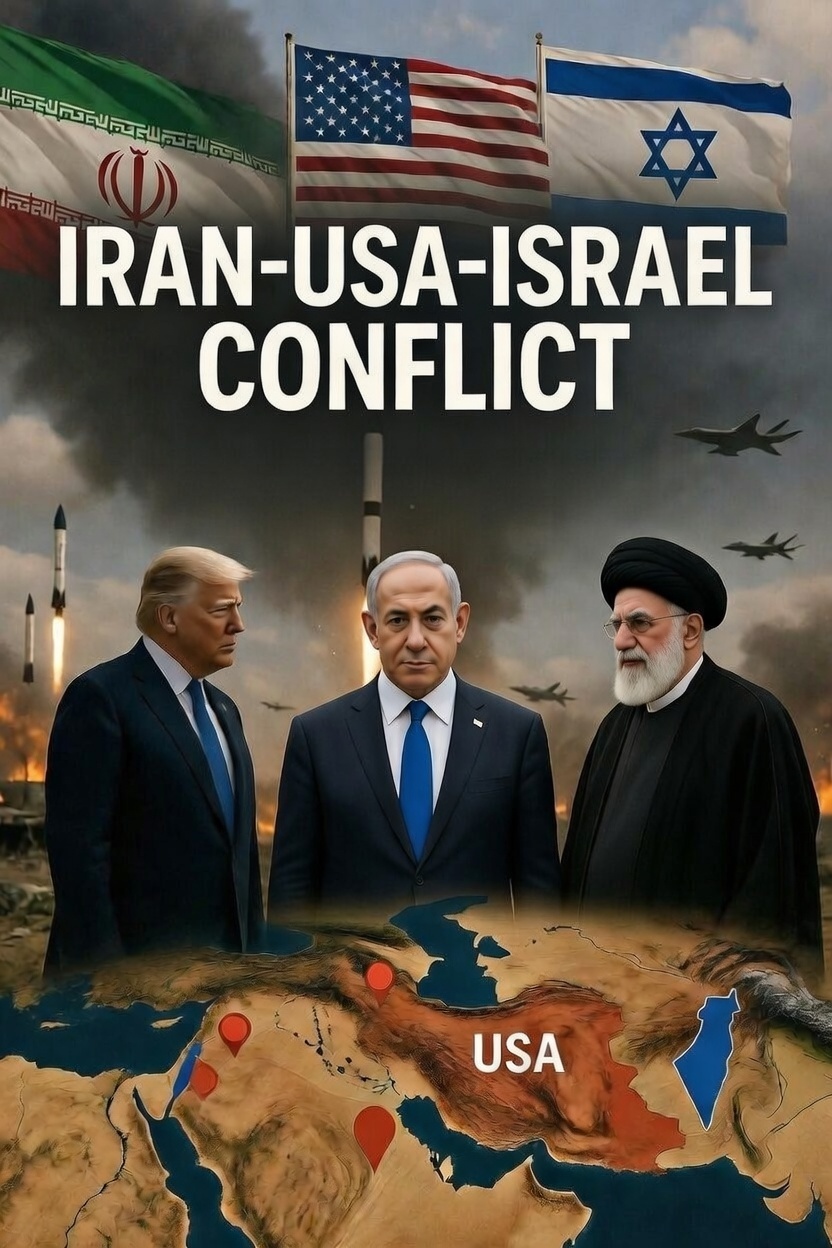
According to current reports, this constitutes a major joint escalation by the United States and Israel against Iran, with explicit regime-change signals from Washington, massive strikes on Iranian command and security structures, and a regional wildfire of retaliatory attacks.
That this is also framed as “support for the Iranian population” is politically understandable. But in wars, “good-sounding” justifications are often not the core of the matter – rather packaging, legitimization, and mobilization.
1) The Basic Pattern: Wars Are Rarely Fought “For Liberation”
The comparison with World War II touches on an important point – though it requires clarification. The Allied war against the Third Reich was not primarily fought to “liberate the Germans” or to save the Jews. The initial war aims were self-defense, the strategic elimination of an expansionist power, alliance obligations, and power politics. The destruction of Germany as a strong state was the objective. Britain at the time was, in a sense, in Israel’s role, and Germany in Iran’s.
That the end of the Nazi regime effectively meant liberation (and that the Holocaust later became central) does not change the fact that states act first according to interests.
This pattern repeats itself today: one may sincerely say, morally, “The mullah system is an unjust regime” – and yet the operational logic remains one of security and hegemonic politics.
2) Israel’s Strategic Core: Eliminating the Last Systemic Counterpower
From Israel’s perspective, Iran has for decades been the center of an anti-Israel regional architecture: missile and drone programs, proxy forces (Hezbollah and various militias), and support for actors that militarily threaten Israel.
If Israel and the United States (as currently reported) attack Iranian command and security structures while simultaneously weakening the internal repression apparatus, this is – strategically – an attempt to permanently break Iran’s ability to project power.
The objective of “liberating the Iranian people” may be compatible with this – but it is not necessarily the driving force. The driving force is the elimination of Iran as the last state-capable adversary within Israel’s direct threat perception. This is classic security logic: neutralize the most dangerous opponent, and you shift the regional balance.
3) A Secondary Benefit from the U.S. Perspective: Indirectly Weakening Russia and China
Whether Washington openly acknowledges it or not – a weakened Iran also affects broader global rivalries.
Russia: Iran is (depending on the phase and issue) a partner, a sanctions-evasion route, a supplier (e.g., military cooperation), and a node in energy and sanctions circumvention networks. A destabilized or more pro-Western Tehran reduces Russia’s strategic depth in the south.
China: China benefits from diversified energy sources and geopolitical bridges into the Middle East. An Iran that is politically realigned or long-term paralyzed complicates Chinese planning in energy, infrastructure, and geopolitical presence.
This does not automatically mean that “China and Russia are the main reason” – but it is a plausible geopolitical bonus in a world where U.S. strategy is increasingly oriented toward great-power competition.
4) Trump as Chess Player: High Risk, Potentially Enormous Gain
Current reporting describes Trump’s line as openly regime-change-oriented (“calling on Iranians to rebel,” continuation and expansion of operations).
Read purely in power-political terms, the “chess move” is this: strike a central adversary at a moment when it is internally vulnerable (protest cycles, legitimacy crisis, economic pressure). This is not humanitarian in motivation, but opportunistic and strategic.
At the same time, the cost is real: regional escalation, oil price risks, attacks on U.S. troops and allies, possible international law and legitimacy debates, and radicalization effects.
A “clever move” will only prove so if the aftermath is not worse than the status quo. Iran could also turn into a SUPER-Iraq, Lebanon, Syria, Libya, or Yemen.
5) The Historical Depth Layer: Iran as an Object of Great Powers (1941, 1953, 1979)
Anyone seeking to understand Iran must accept this: for over 100 years, Iran has been a geostrategic crossroads, and great powers have repeatedly intervened – often with moral justifications, almost always with hard interests.
5.1 The 1941 Occupation: Oil, Supply Lines, Lend-Lease – and the “Persian Corridor”
In 1941, Britain and the Soviet Union occupied Iran (Operation “Countenance”) to secure two things:
-
Oil interests (especially British interests in the region)
-
Supply routes to sustain the Soviet Union against Nazi Germany – the so-called Persian Corridor, through which a significant portion of U.S. Lend-Lease deliveries passed.
This illustrates the core mechanism: Iran was not a “partner on equal footing,” but a transit and resource space in a world war. The moral narrative (“against Hitler”) was true – yet within that truth, interests were enforced ruthlessly.
5.2 1953: The Overthrow of Mossadegh – Oil Nationalization, British Interests, U.S. Calculations
In 1951/52, the conflict over the nationalization of the Iranian oil industry under Prime Minister Mohammad Mossadegh escalated. In 1953, Mossadegh was overthrown in a coup in which British and U.S. intelligence services were involved (Operation Ajax). This is now well documented through declassified files and historical research.
The dual motivation was key:
-
Oil and economic interests (especially British)
-
Cold War / fear of instability: U.S. decision-makers feared Iran could descend into chaos and that communist forces might benefit.
The result was a monarchy supported by the West and closely integrated into Western security structures – domestically authoritarian and increasingly illegitimate.
5.3 1979: Revolution – “Abandoned by the West” or “Encouraged by the West”?
Here things become complex, and this is where major myths arise. There are three levels:
Fact: Prior to the revolution, there were contacts between U.S. representatives and Khomeini’s circle; declassified documents and reports address this.
Interpretation A: Washington attempted damage control, kept options open, and sought to avoid civil war – without intending to “install” Khomeini.
Interpretation B: The West consciously elevated Khomeini, partly due to miscalculation and partly through an ideological lens (“anti-imperial,” “post-colonial,” “woke”), thereby strengthening forces that ultimately ruled in an anti-Western manner. Some critics also point to later gestures of engagement or dialogue by Western political figures as examples of misjudgment rather than strategic foresight.
What remains serious and historically grounded is this: the claim that “the West deliberately created the Islamic Republic” is not substantiated as a hard fact. What is documented is a mixture of miscalculation, opportunism, internal contradictions, contacts, and attempts to retain influence in a collapsing system – which is not the same as actively promoting it.
6) A Pahlavi Return: Solution, Symbol, or New Problem?
Whether a return of the Pahlavi family (or a monarchical restoration idea) would be helpful depends on three factors:
Internal legitimacy: Part of the opposition is monarchist or nostalgic; another part explicitly seeks a republican, secular order. A return “from the outside” could quickly appear as a foreign project.
Institutions over personalities: Even if a symbolic figure stabilizes the situation, what is required is rule of law, security sector reform, separation of powers, minority protection, and economic reform. Otherwise, one elite merely replaces another.
Regional acceptance: Neighbors and great powers react less to a name than to orientation: neutral, Western-aligned, anti-Western, expansionist?
In short: Pahlavi could function as a transitional symbol – or as a divisive force. The decisive factor is whether a new system is organized inclusively and creates security without a revenge ideology.
7) Speculation About Possible Dependencies of Trump
The claim that Donald Trump may have been under pressure from Benjamin Netanyahu in connection with so-called “Epstein files” has not been substantiated by reliable, publicly verifiable sources. Such assumptions belong to the realm of political speculation.
A responsible journalistic formulation could at most read:
“In social media and political debates, speculation circulates about possible personal or political dependencies; publicly verifiable evidence for this is currently lacking.”
8) The Core Conclusion: An Iran Without the Mullah Regime Would Be Better – But Not Automatically Peaceful
Here, blunt honesty is warranted:
Yes: An Iran without theocratic rule, without the Revolutionary Guards as a state within the state, without the export of ideological confrontation, would likely be more predictable for the region.
Yes: It would objectively be more favorable to Western interests (energy, trade routes, partner security, and the containment of proxies).
Yes: Russia and China would potentially lose a geopolitical lever or partner.
But:
Regime change is not an endpoint, but the beginning of the most dangerous phase: power vacuum, factional struggles, possible fragmentation, revenge cycles, militia economies.
The moral balance sheet depends on “the day after”: protecting civilians, avoiding collective punishment, and constructing viable institutions.
If one formulates it in terms of power politics (without ideological insults):
A post-theocratic Iran could make peace in the region more likely – while simultaneously strengthening the dominance of the United States and its allies. That is presumably the central logic currently driving decision-making.
Recent posts
See AllPrague Forum Membership
Join us
Be part of building bridges and channels to engage all the international key voices and decision makers living in the Czech Republic.
Become a member