- Hans Weber
- October 8, 2026
An Iran Without the Mullah Regime: Desirable – but Strategically well Calculated?
By Hans Weber
Iran Without the Mullah Regime: Morally Desirable, Strategically Calculated
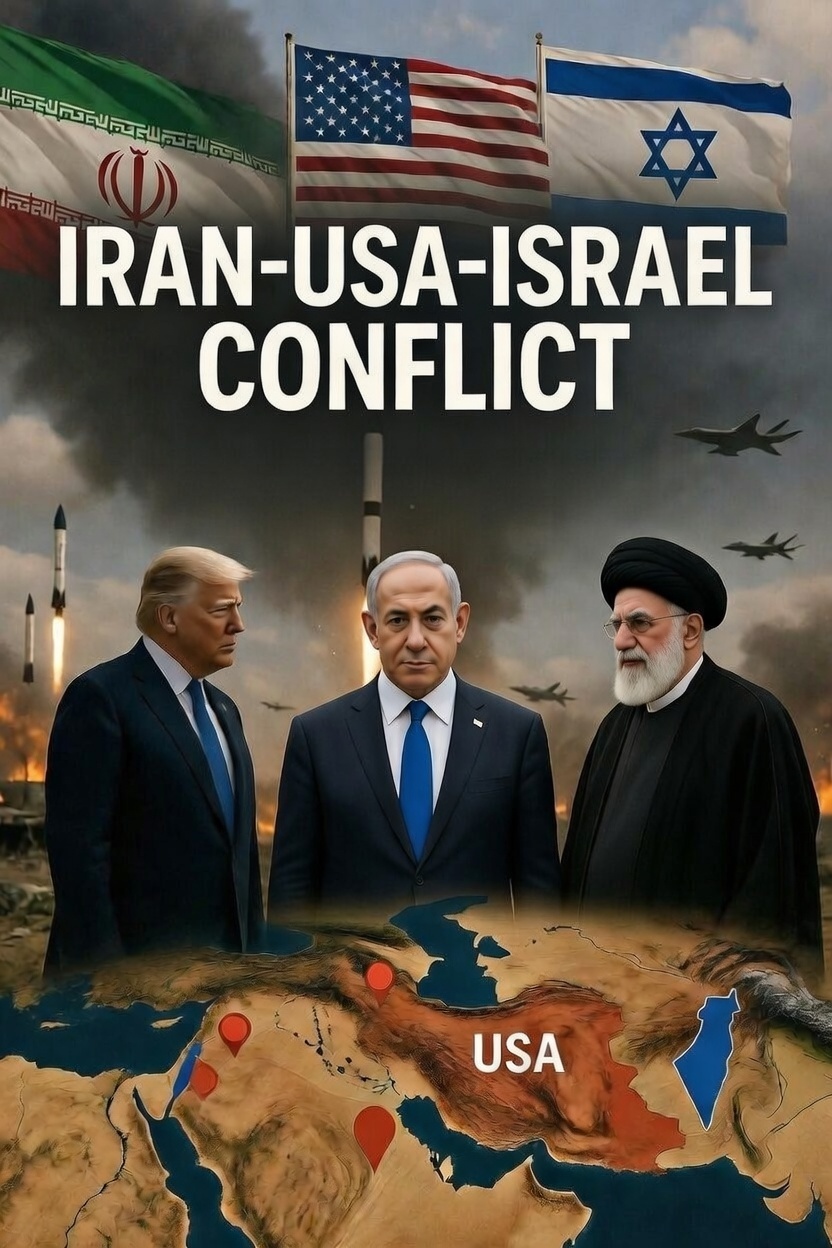
An end to theocratic rule in Iran would represent liberation for many people in the country. Yet the crucial question is: Is the potential liberation of the Iranians truly the reason for the current geopolitical escalation? A look at history suggests that moral arguments in international conflicts are often merely accompanying music—while strategic interests set the actual rhythm.
A Country Between Repression and Hope
An Iran without the mullah regime would be a liberation for many Iranians. This is not a provocative thesis, but a sober observation when considering four decades of political repression, executions, forced religiosity, the power of the Revolutionary Guards, economic stagnation under sanctions, systemic corruption, and the violent suppression of protest movements. Millions of Iranians have repeatedly shown in recent years that they yearn for a different political system. Protests against the regime have now become part of the country’s political everyday life. Yet one decisive question remains: Is the liberation of the Iranian population actually the reason for the current military escalation against Tehran?
From a historical perspective, the answer is frequently: No.
States rarely act primarily out of moral motives in international politics. Moral arguments certainly play an important role in political communication, but they often serve more for legitimation than for actual decision-making.
“Well-sounding moral justifications frequently accompany wars—but they are rarely their true trigger.”
The Basic Pattern of International Politics
A glance at history shows that military interventions almost always arise from a mix of security interests, geopolitical calculations, and power politics. World War II is often cited as a moral reference point. Indeed, the Allies’ victory led to the liberation of Europe from one of history’s most brutal dictatorships. Nevertheless, this was not the original motive for the states’ entry into the war. Britain initially fought for its own survival. The United States entered the war only after the attack on Pearl Harbor.
The liberation of Europe was a historical consequence, but the original motives were strategic in nature. The USA did not go to war to liberate the Germans or save the Jews. Israel is maybe in the same positio lie Great Britain in 1940 and Iran as Germany.
This pattern recurs in many international conflicts.
Israel’s Strategic Perspective
From Israel’s perspective, Iran has been the most important strategic adversary in the Middle East for decades. The Iranian leadership openly questions Israel’s existence and supports militant actors in the region, including Hezbollah in Lebanon as well as various militias in Syria and Iraq. Added to this are Iran’s missile program and the expansion of military drone technology.
These capabilities significantly alter the strategic balance in the region.
From Israel’s perspective, it is therefore rational to permanently weaken Iran as a geopolitical opponent. Military attacks on command and security structures, as well as the weakening of the power apparatus, can therefore be interpreted as part of a long-term security strategy.
“The fall of a regime is not the end of a conflict—it is often only the beginning of the most difficult phase.”
The Global Dimension: Russia and China
From the American perspective as well, a weakened Iran would have geopolitical consequences that extend far beyond the Middle East. Iran has become a partner to Russia in various areas, including military cooperation, economic collaboration, and ways to circumvent Western sanctions. A politically destabilized or realigned Tehran could therefore significantly weaken Russia’s strategic position in the Middle East. China also pursues long-term interests in Iran. Beijing is interested in stable energy imports and views the country as a potential component of its global infrastructure strategy.
An Iran that is politically unstable or geopolitically realigned would considerably complicate these plans.
Iran as a Geopolitical Nexus of Great Powers
Over the decades, Iran has repeatedly been the object of geopolitical interventions by major powers. A particularly clear example is the occupation of the country in 1941 by Britain and the Soviet Union. Large parts of American Lend-Lease supplies to the Soviet Union in the fight against Germany flowed through the so-called Persian Corridor.
At the same time, Iranian oil played a central role. Iran was thus not only a state in the Middle East but also a strategic nexus of global power politics.
Another key event was the overthrow of Iranian Prime Minister Mohammad Mossadegh in 1953. After Mossadegh nationalized the Iranian oil industry, British and American intelligence agencies supported a political coup that ultimately restored the Shah’s power. He remained a close Western ally for the following decades but ruled increasingly autocratically at home.
The Islamic Revolution of 1979 finally ended this political order. To this day, debate continues over what role Western actors played in the final months of the monarchy. What is historically established above all is that the revolution resulted from complex internal Iranian developments, amplified by international misjudgments and miscalculations.
The Iran-Iraq War: A Textbook Case of Geopolitical Proxy Wars
The Iran-Iraq War of the 1980s illustrates particularly clearly how regional conflicts can become part of larger strategic rivalries. Just one year after the Islamic Revolution, Iraqi President Saddam Hussein attacked Iran. The war developed into one of the bloodiest conflicts of the late 20th century. The United States supported Iraq indirectly, including through intelligence information and diplomatic cooperation. The primary goal was to prevent a victory by revolutionary Iran.
Parallels to the War in Ukraine
The Iran-Iraq War is considered a classic war of attrition. Both sides initially expected a quick military success, but instead the conflict turned into years of positional warfare. A similar dynamic can be observed in the war in Ukraine. There, too, a conflict originally intended as a rapid military strike developed into a protracted war with high military and economic costs. In both cases, external powers play an important role. States indirectly support one of the two sides, turning a regional conflict into part of larger geopolitical rivalries.
The Question of a Possible Pahlavi Return
Within the Iranian opposition, a possible return of the Pahlavi dynasty is occasionally discussed. The son of the last Shah appears internationally as a political activist and is supported by parts of the diaspora.
However, it is unclear whether such a solution could actually have a stabilizing effect. A political transition depends less on individual personalities than on the ability of a new system to build functioning institutions. Rule of law, separation of powers, economic reforms, and societal reconciliation would be decisive for long-term stability.
Why Regime Change Often Generates New Instability
The idea that the fall of an authoritarian regime automatically leads to stability and democracy has proven illusory multiple times in recent history.
The Iraq War of 2003 is a particularly stark example. The overthrow of Saddam Hussein eliminated a brutal dictatorship, but the subsequent collapse of state structures led to years of instability. Militias, religious conflicts, and ultimately the rise of the so-called “Islamic State” were direct consequences of this power vacuum.
A similar pattern emerged in Afghanistan, Libya, and Syria after the NATO intervention of 2011. There too, the fall of Muammar al-Gaddafi and Assad did not lead to a stable state but to the fragmentation of the country into rival power centers and militias.
Conclusion
An Iran without the mullah regime could indeed represent a chance for greater stability in the region. At the same time, such a change would also be advantageous for Western states from a geopolitical perspective.
Yet a regime change is not an endpoint.
It is rather the beginning of the most difficult phase of political transformation. The decisive question is therefore not only whether a regime falls, but what emerges afterward.
No one knows what Trump and Netanyahu’s objectives are. Neither do we have the intelligence information they do. Hopefully, it is good enough. It would not be the first time America has gotten involved in a much longer war than expected. Somehow, I fear that this is exactly what Netanyahu wants. You should also not underestimate Iran’s resilience. Remind the story of the hydra in ancient Greek mythology. Also, the Wehrmacht’s attack on the Soviet Union failed. They completely underestimated the enemy.
History shows that political systems can rarely be replaced as planned. Stability does not arise solely from the fall of a government, but from the long-term building of functioning institutions. Precisely for this reason, Iran’s future remains one of the central geopolitical questions of our time.
Recent posts
See AllPrague Forum Membership
Join us
Be part of building bridges and channels to engage all the international key voices and decision makers living in the Czech Republic.
Become a member