- Hans Weber
- March 21, 2026
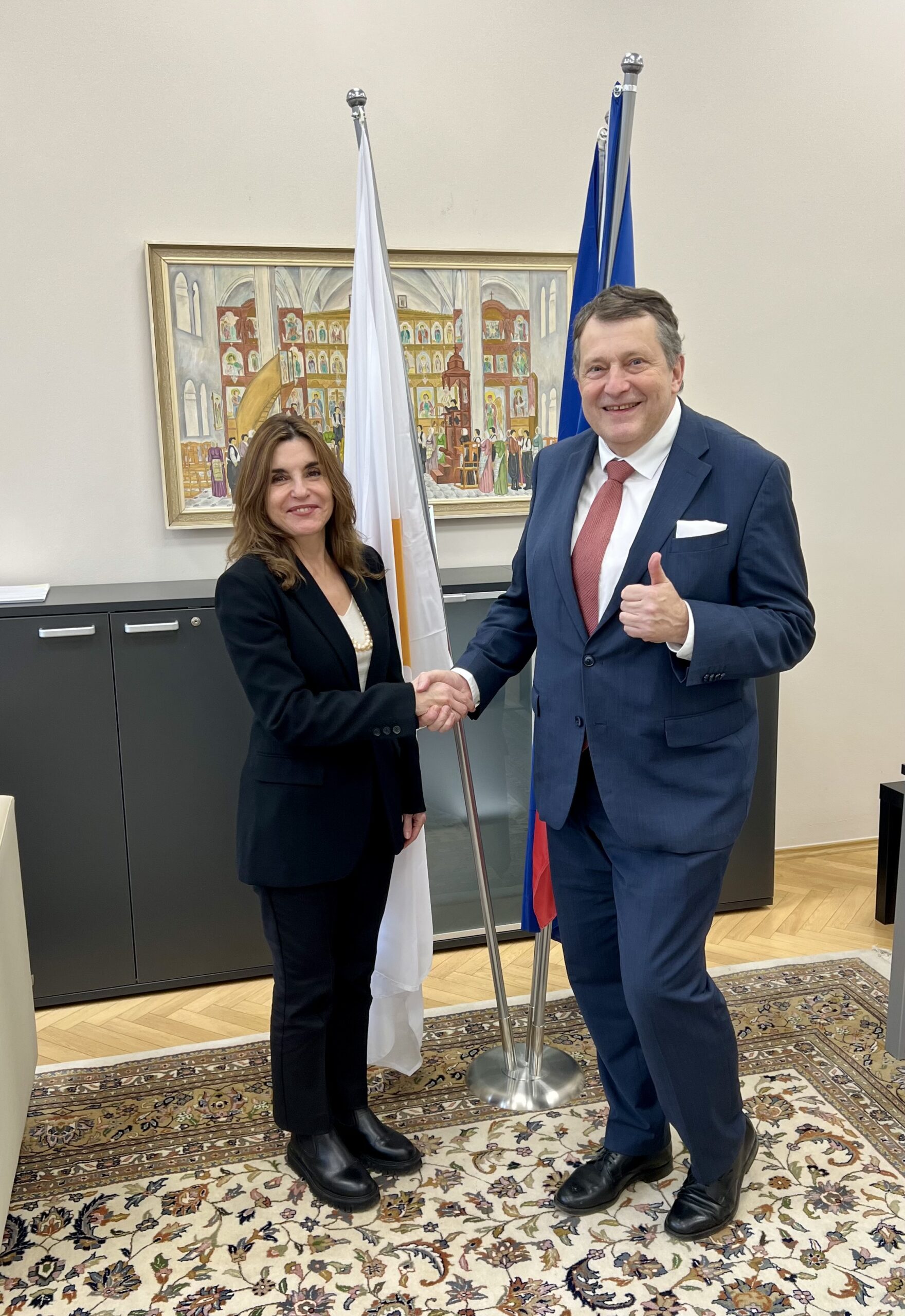
Interview with H.E. Aliki Pascali, the Ambassador of the Republic of Cyprus
Interview with H.E. Aliki Pascali, Ambassador of the Republic of Cyprus
The Republic of Cyprus has a long and complex history: from ancient civilizations and Byzantine rule, through the period of the Crusaders, Ottoman and later British administration, to independence in 1960. Since the Turkish military intervention in 1974, the island has remained de facto divided, with the northern part under Turkish control – a situation that remains one of the unresolved issues within Europe.
Against this historical and geopolitical background, Cyprus assumed the Presidency of the Council of the European Union on 1 January 2026, at a time of profound geopolitical tensions and internal challenges for the EU.
- Mrs. Ambassador, Cyprus assumed the Presidency of the Council of the European Union on 1 January 2026. What political priorities has your country set at a time when the EU is facing geopolitical crises, economic pressure, and internal divisions?
It is obvious that, in the current geopolitical environment in our wider neighbourhood, security should be at the top of our Presidency’s agenda. The continuing Russian aggression in Ukraine, threats against Member States, not to mention violations of their air space, the situation in the wider Middle East, shifting US global posture, including recent events that occurred in the Western Hemisphere, are all factors that impose security and stability as priorities.
It is for these reasons imperative that the EU’s collective security capacity should be strengthened, and cooperation with Middle Eastern partners be deepened, in order to promote stability in the region.
An open Union is open to all its neighbours, East and South. The Cyprus Presidency will work to revitalise the Union’s engagement with its Southern partners and the Gulf. A stronger and more strategic partnership with the Southern Neighbourhood is a long-term investment in regional peace, stability, prosperity and security. The New Pact for the Mediterranean provides a renewed framework for tangible, results-oriented cooperation.
Migration is another major issue and concern for many Member States, especially those like Cyprus which are in a frontline position; it remains a divisive issue, especially between Mediterranean and northern states.
Reinforcing and implementing stricter external border controls and ensuring increased and more effective repatriations of irregular migrant are the obvious choice. Strengthening the EU’s external borders remains essential for safeguarding the Union’s security and ensuring the effective management of migration flows. To this end, we will seek to enhance operational cooperation, combat illegal migration, and disrupt smuggling networks. Secure external borders are a prerequisite for a credible and sustainable migration policy.
Also, implementation of the new EU Pact on Migration and Asylum would also contribute to better dealing with the problem.
A strong economy is first and foremost about the prosperity, the well being and social cohesion for the benefit of citizens.We have, therefore, to ensure that the EU budget and the post‑2027 Multiannual Financial Framework (MFF) – a central task for the presidency – support these goals, as well as sustainability and reducing EU red tape in order to boost competitiveness.
Our aim is to guide discussions in a way that will facilitate reaching political agreement on the MFF by the end of 2026. The stakes are high, and this will be reflected in the difficulties of negotiations. But we retain our ambition on this most crucial of files.
Our ambition is to build on the progress achieved, significantly advance negotiations on all sectoral legislative files of the proposed MFF. In this respect, we will work constructively and in a transparent manner with all relevant actors to shape a balanced framework to produce a mature and comprehensive negotiating box with figures for June’s European Council.
Disagreements on budget are a major source of internal division. The Commission, Parliament, and Council, all highlight the urgency of reaching a swift agreement on the next MFF.
In the current situation, security and economy are more than ever interlinked and interconnected. You cannot provide security to your citizens, without the necessary financial means. This is an additional incentive and motive to work, in order to promote a more resilient EU economy, capable of responding to extraordinary situations and withstanding shocks.
In nearly 70 years of existence, of what is today the EU, there have always been internal divisions, albeit not of the same nature.
I think that, in the current context, geopolitics, migration, budget constraints, and, as always, differing national priorities, are the main issues where differences exist between Member States.
I have already highlighted what the approach of the Cyprus Presidency will be in dealing with them, in order to achieve unity on shared positions.
There are, of course, other equally important issues on the Agenda, such as enlargement, EU values, openness, delivering to citizens, policies that directly benefit citizens and global engagement, to mention a few; emphasis will also be given to them, however, for objective and obvious reasons, the priorities I mentioned are the most pressing ones.
- The European Union is under pressure to strengthen its strategic autonomy. Which concrete initiatives does Cyprus intend to advance during its Presidency, particularly in the areas of foreign policy, security, and the Mediterranean region?
I have already indicated that the Middle East is an area of interest and concern, not only because of its geographical proximity to the EU, but also because of the potentially serious security and stability repercussions that further deterioration of the situation might have in the EU.
Deepening therefore EU engagement and cooperation with the Middle Eastern partners, is of vital importance.
It aims to position the EU as a more active diplomatic actor in the region, including on humanitarian and security issues.
Also, Cyprus intends to advance and prioritize cooperation with southern Mediterranean and third countries, focusing on migration, energy, and regional stability, in order to better manage flows and address root causes.
Recent developments, such as the lifting of arms embargoes by the US and Norway, reflect the growing role of Cyprus as a “credible, predictable and dependable security enabler” in the Eastern Mediterranean. The Presidency will leverage this to strengthen EU strategic partnerships in the region.
Other initiatives on Security and Defence include implementing the White Paper on the Future of European Defence and the accompanying Readiness Roadmap 2030, aiming for the strengthening of EU defence capabilities and enhancing EU crisis preparedness.
One of the Presidency’s five pillars is “autonomy through security, defence, and readiness”, which includes improving the EU’s ability to respond to crises and external shocks.
Given its geographical position, Cyprus will also emphasize maritime security in the Eastern Mediterranean, including freedom of navigation and protection of critical sea lanes.
- Cyprus is a relatively small member state, with a particular geopolitical position. Do you view this more as a limitation or an advantage when serving as an honest broker in the European Union?
Influence does not depend on size, but rather on the ability to make the most of one’s relative advantages. The “weight” of a Member State is not only determined by square kilometres, but also by its know-how, efficiency and commitment to strengthening the “European project”.
As it has been evidenced during the Gaza crisis, Cyprus, due to its geographical position, facilities and infrastructure, swiftly and effectively provided humanitarian aid (the “AMALTHIA” plan – humanitarian corridor), in close cooperation with its European, American and regional partners.
Also, by leveraging its proven track record in supporting humanitarian operations, Cyprus can promote and facilitate policy discussions on rapid deployment mechanisms, showcasing best practices, such as the “ESTIA” plan
These experiences reinforce our conviction that Europe’s credibility lies in its ability to act decisively and compassionately.
Frontline states often experience challenges earlier and more intensely. The Cyprus Presidency can build on this experience, to strengthen cohesion, focusing on what unites Member States: security, stability and tangible results for citizens.
- The Czech Republic has recently formed a new government. How do you assess Cyprus’s relations with the new Czech government, and where do you see differences compared to cooperation with the previous administration?
Cyprus, since its independence in 1960, has always maintained excellent relations in all fields, with Czechoslovakia at the time, and with the Czech Republic, since the “velvet divorce” in 1992.
Our relationship is based on shared principles and values: Democracy, the rule of law, respect for Human Rights, free market economy. In 2004, we acceded together in the European Union and this relationship was further enhanced and deepened.
For these reasons, our relationship goes beyond political changes in either country.
It is naturally normal that divergences of opinion might exist between partners. I have already had the opportunity to meet with leaders of both, the previous and the new Czech government; from our discussions, I haven’t noticed any differences regarding our bilateral relations.
- Economic competitiveness is a key issue across Europe. What role does Cyprus aspire to play within the EU in the coming years – as a financial and services hub, an investment gateway, or also as an innovation-driven economy?
See below under 7
- In the past, Cyprus has faced international criticism regarding so-called “golden passports”. How does your Government respond to this criticism today, and what concrete changes have been implemented to ensure transparency and full compliance with European standards.
It is true that there has been criticism regarding the “Cyprus Investment Programme” (CIP), commonly known as “golden passports”.
The CIP was a “citizenship‑by‑investment” scheme that allowed foreign investors to obtain Cypriot (and therefore EU) citizenship in exchange for significant financial investment. It operated from 2007 until its suspension in 2020.
It is not a secret that the Programme had gone off its intended purpose, especially following the financially crisis of 2013.
As a consequence, the Government decided to terminate the CIP in August 2020, acknowledging its weaknesses and deficiencies. In September 2020, the Attorney General appointed an Investigative Committee, tasked with reviewing all naturalizations granted under the CIP from 2007 until August 2020, in order to determine:
– Compliance with the applicable criteria and conditions at the time of naturalization.
– Identification of any potential criminal or disciplinary offenses.
– Submission of recommendations for deprivation of Cypriot citizenship.
Following the investigation, measures were adopted and implemented, including the establishment of a special committee, responsible for revoking passports obtained through false representations or by individuals later charged with crimes, as well as those subject to sanctions or with a compromised criminal or ethical background.
Since the program’s termination, the Cypriot government has taken several concrete steps to address the fallout and align with European Union expectations:
– Full Legal Abolition of the CIP: In December 2025, Cyprus closed the final legal loophole that had allowed the Council of Ministers to grant citizenship under “special contribution” provisions. From now on, all naturalizations must follow the standard, residence-based process under the Aliens and Immigration Law.
– Revocation of illegitimate passports: The Government has actively reviewed and revoked citizenships granted under questionable circumstances. Consequently, over 330 “golden” passports have been rescinded, including those of high-profile individuals, such as Russian oligarchs and politically exposed persons.
– New Revocation Mechanism: Legislation passed in October 2025 introduced a formal process for revoking citizenships obtained through the now-defunct investment scheme. This legal framework was developed in consultation with the European Commission and received its approval.
Today, all forms of investor-based naturalization have ceased.
As a result 122 passports had been revoked and a total of 332 “golden” passports have been annulled.
These reforms bring Cyprus in line with European Commission recommendations and Court of Justice rulings, which emphasize that EU citizenship must reflect a genuine link to the Member State.
- Despite this debate, many European entrepreneurs remain interested in investing in Cyprus. What makes the country attractive today – and where should investors also realistically expect challenges?
There are many reasons that make Cyprus attractive for entrepreneurs and investors.
I will start with the country’s strategic geographical position, an EU Member State, between Europe, the Middle East, and North Africa and the excellent bilateral relations it maintains with its neighbouring countries.
Furthermore, the English‑speaking legal and business environment (accounting and corporate services), English‑speaking workforce, the EU regulatory framework, strong corporate services and shipping sectors, skilled workforce, business‑friendly tax regime, upgraded credit ratings (Moody’s and Fitch: A), strong fiscal discipline and banking sector reforms, add to the country’s attractiveness for investors.
These position Cyprus as a gateway for companies entering the EU market, especially from the Eastern Mediterranean and Middle East and make Cyprus an “economic connector”, an entry point for investment into the EU from the Middle East and Asia, and vice versa.
Our Presidency agenda stresses resilience and global engagement, suggesting a desire to act as a bridge between regions.
Cyprus has achieved upgraded credit ratings, with agencies such as Moody’s and Fitch placing it in the A category, reflecting strengthened economic fundamentals. Also, the IMF notes that Cyprus posted a 4.3% fiscal surplus in 2024 and reduced public debt to 65% of GDP, highlighting strong fiscal discipline.
The banking sector, following the 2013 crisis, was drastically reformed and has become more resilient, while banking stability has significantly improved.
The IMF and EIB both emphasize that Cypriot firms are investing, innovating, and adopting digital tools, supported by a more stable financial environment.
With regard to innovation and digital adoption, the EIB has recently noted that Cypriot firms are increasingly adopting advanced digital tools, including AI, and investing in innovation.
Finally, Cyprus has in recent years emerged as location for startups, with one of the best first‑year survival rates in the EU.
- Looking ahead at the future of the European Union: Where do you see Cyprus in ten years’ time – more deeply integrated into the EU, more autonomous, or both at the same time?
The answer, obviously, does not depend on Cyprus alone. It depends on the course that the Union will take in the coming years, which in turn depends on a number of unknown elements and factors, such as the security situation on the continent, the pace of enlargement, the economy et.c. For these reasons a long-term prediction would be risky and uncertain. There are areas where more integration might be generally desirable and there are areas where more autonomy is probably a better choice. I cannot, therefore, give a straightforward answer, because there are a lot of unknowns.
- On a personal note: What does it mean to you, as Ambassador, to represent your country at a moment when Cyprus is once again playing a central role on the European stage?
More responsibilities, more work, more challenges, more experience, more opportunities, both professional and for the country I represent.
- Mrs. Ambassador, the division of Cyprus has shaped the country for more than fifty years. How challenging is it for Cyprus to promote European unity during its EU Presidency while an EU candidate country continues to militarily control part of its sovereign territory?
Promoting European unity is for us a challenge and an incentive, precisely because of the de facto division of our country. We are in a better position to understand what is at stake. For us, like it was for the Germans until the 1990s, the unity of our country is an existential challenge. European unity is of course of a different nature, but here I am talking about how one perceives unity.
- Turkey plays an increasingly crucial geopolitical role for Europe. What expectations does Cyprus have towards Brussels in its approach to Ankara, and where do you see clear red lines that should no longer be relativized?
Allow me first a general remark: Defence and security and support for Ukraine, I have said it already, will be a priority of our Presidency. As a Member State, whose territory is under military occupation for more than five decades, we know the stakes.
As a matter of priority, we shall promote common defence and security interests of the Union, taking into consideration all relevant institutional decisions, as well as legitimate concerns of our partners.
With regard to Turkey, as everyone else, we certainly acknowledge its potentially important role in European security.
We fail, however, to see how a candidate country, with a Common Security and Foreign Policy alignment rate as low as 4%, is perceived as demonstrating a constructive stance of security policy issues, let alone its positions in relation to Hamas and other terrorist entities, where its leaders openly support them.
Furthermore, Turkey does not comply with EU sanctions against Russia and in fact facilitates the circumvention of such sanctions and the transiting from its territory of sensitive and dual use material to Russia. Not to mention Turkey’s role in circumventing sanctions against Iran.
Having said this, it is clear that we’ll only be guided by the EU institutional decisions, by which we are naturally bound.
However, in our national capacity, we shall maintain the same position as we did under many previous Presidencies and this should not by any means be interpreted or perceived as serving national interests.
We have always stood ready for mutually beneficial progress in EU – TR relations in a phased, proportional and reversible approach, and on the basis of specific, tangible steps from Turkey in line with relevant conditionality, including vis-à-vis Cyprus and the Cyprus problem.
Turkey remains a candidate country and we continue to firmly believe that the enlargement framework provides the sole comprehensive framework through which the country can remain anchored to the EU. The European Council Conclusions of April 2024 is a very clear framework for the phased, proportionate and reversible effort to re-engage with TR, whose progress is depended on TR’s own constructive engagement, across the board, including the Cyprus Problem.
The Cyprus Presidency intends to act as an honest and fair mediator, our approach will be guided strictly by our institutional responsibilities, ensuring equal treatment of all candidate countries, fully anchored in the established framework of EU – Turkey relations, just as we did in 2012, when we successfully concluded the EU – Turkey Visa Liberalisation Roadmap. In this spirit, we intend to invite all candidates and potential candidates, including Turkey, to the informal GAC that will take place in Cyprus in March 2026.
Cyprus’ strategic objective remains having a neighbouring country that is closer to the European Union and aligned with its values.
Just like all other enlargement countries, we continue to expect from Turkey to do all that it takes in order to advance towards the EU membership, including by implementing fundamental obligations it has assumed towards the EU, in relation to Cyprus, which 20 years later still refuses to implement.
Looking forward, our position remains consistent: Turkey is a candidate country, and we continue to believe that the enlargement framework is the only comprehensive structure capable of anchoring Turkey to the European Union. But like all candidates, Turkey must fulfill its obligations if it wishes to advance on the path to membership. This includes honouring long-standing commitments toward the EU and toward Cyprus commitments that remain unimplemented two decades later.
- Previous reunification efforts, including the Annan Plan, have failed. From your government’s perspective, are there realistic new approaches to a settlement, or is the conflict currently rather in a phase of being frozen?
The reunification of the island and the termination of the military occupation of the its northern part by Turkey has been a priority objective of successive Cypriot governments. This reunification has to be based on the relevant United Nations Security Council Resolutions regarding Cyprus and, naturally, on the EU values and principles.
Security Council Resolutions provide for a federal solution in Cyprus, something that the Turkish side does not accept and promotes instead a solution of two separate states.
After several years of stalemate, there is now a new UN-led initiative for the resumption of negotiations for an agreed settlement.
Recent posts
See AllPrague Forum Membership
Join us
Be part of building bridges and channels to engage all the international key voices and decision makers living in the Czech Republic.
Become a member