- Hans Weber
- March 21, 2026
Interview with H.E. Mr. Raveesh Kumar Ambassador of India to the Czech Republic
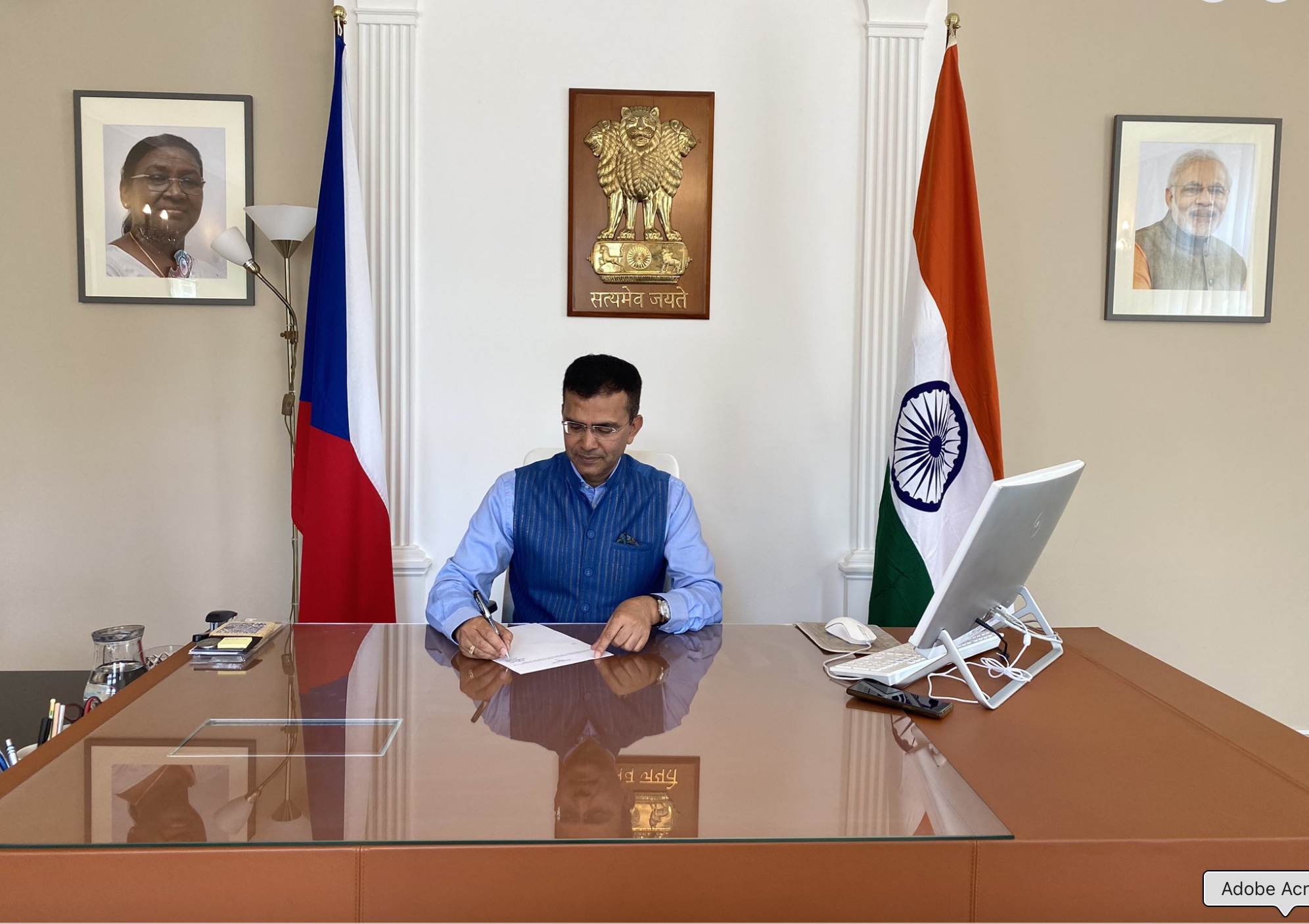
H.E. Mr. Raveesh Kumar, Ambassador of India to the Czech Republic gave us the opportunity to discuss with him the rising role of India in a new multipolar world within the BRICS-Organisation and his role among the powers.
- Your Excellency, you assumed your post as India’s Ambassador to the Czech Republic in 2024. How would you describe the current state of India–Czech relations compared to when you arrived, and what have been your main priorities so far?
Thank you for this opportunity. Let me begin by wishing your readers a very happy New Year. It’s hard to believe that it’s already been 18 months since I arrived in this wonderful city. When I look back, I would say that our relations remain warm, steady and forward-looking and both sides are keen to take this partnership to the next level.
I have got an amazing Team at the Embassy and we have taken proactive steps to add to the positive momentum by deepening the conversation between our two countries across different dimensions, and making us more visible to one another. Our priorities have been quite focused: expanding and diversifying trade, encouraging more Czech investment in India, and supporting the growing presence of Indian companies here in Czechia. We have also placed strong emphasis on cooperation in higher education, research, mobility, tourism and people-to-people ties — areas where our collaboration can truly shape the future.
Another important part of my work has been engaging closely with the vibrant Indian community in Czechia, and building a sense of shared purpose so that their successes and experiences can feed into the broader canvas of India–Czech relations. In many ways, they are among our strongest bridges of friendship.
- The Czech Republic has recently formed a new government. In what ways have bilateral cooperation and political dialogue with Prague changed under the new leadership compared to the previous government?
We warmly congratulate the new government led by Prime Minister Andrej Babiš. Prime Minister Narendra Modi was among the first to extend his greetings, recalling their meeting in 2019 during Mr. Babiš’s visit to India for the Vibrant Gujarat Summit — a meeting I remember well, as I was present in my earlier role as Spokesperson. It was constructive and forward-looking, and that spirit continues to guide our engagement today.
With the new leadership in Prague, the tone of our political dialogue remains positive, steady and pragmatic. We expect a continued emphasis on economic cooperation, innovation, technology partnerships and closer engagement between our institutions and businesses. There is also a shared recognition that our relationship has a strong strategic potential — not just bilaterally, but in the wider European and Indo-Pacific contexts.
In that sense, the new government offers continuity with fresh energy. We look forward to building on what has already been achieved and taking the relationship to an even more substantive level in the months ahead.
- Trade and investment relations between India and the Czech Republic continue to deepen. Which sectors do you see as particularly promising for future cooperation, and how can both countries further unlock their economic potential?
Bilateral trade between India and the Czech Republic has grown significantly in recent years — in fact, it has almost doubled over the past five years, which reflects on the strength and resilience of our economic partnership. What excites me now is the scope to take this even further by looking at sectors where our strengths complement each other and the opportunities presented by rising tariff in certain geographies and the promise of India-EU Free Trade.
I see particularly strong potential in electronics, pharmaceuticals, textiles and modern manufacturing, as well as in agricultural products such as tea and coffee. There is also growing interest in areas like mobility, green technologies and engineering solutions, where Czech expertise and India’s scale can work very well together.
On the investment side, India offers Czech companies a large and dynamic market, supported by improving infrastructure, digitalisation and an increasingly business-friendly environment. At the same time, we are encouraging more Indian companies to explore opportunities here in Czechia, whether in innovation, technology partnerships or niche manufacturing.
The way forward, I believe, lies in deeper business-to-business engagement, stronger supply-chain linkages, and continued dialogue between our institutions. We are working closely with the Czech institutions like Ministry of Industry and Trade, Czech Invest, Czech Trade, Czech Chamber of Commerce, SPCR to highlight business opportunities between both countries.
- India is a key member of the BRICS grouping, together with Brazil, Russia, China and South Africa. How do you see India’s role within BRICS evolving in the coming years, especially in light of differing strategic interests among its members?
India views BRICS as a valuable forum for shaping a fairer and more inclusive global order — one that gives a stronger voice to emerging and developing countries. As India’s External Affairs Minister Dr. S. Jaishankar has often said, our approach to BRICS is practical and focused on working together where it truly makes a difference for development and better global governance.
Looking ahead, India’s role in BRICS will keep evolving in a few key areas. We’ll continue deepening economic and financial cooperation to support sustainable growth, stronger supply chains and innovation. Today, the focus is also on stabilizing the international economy and the world order, and it is equally important for the group to focus on ongoing conflicts, not least because they have direct developmental and supply chain implications.
Of course, BRICS brings together countries with different perspectives and priorities — and that diversity is natural. India approaches these differences with confidence and maturity: we work closely where our interests align, and where they don’t, we engage constructively while staying true to our national interests and independent foreign policy. In many ways, the real strength of BRICS lies in managing this diversity while still moving toward shared goals — and India will continue to play a steady, bridging and solutions-oriented role in that effort.
- India’s relationship with China is often described as complex and sometimes challenging, despite both countries being members of BRICS. How does India manage this dual dynamic of cooperation and competition, particularly in the Asian region?
India’s relationship with China is indeed complex — there are areas where our interests overlap and others where they diverge. As India’s External Affairs Minister Dr. S. Jaishankar has often emphasized, India approaches this relationship with a clear-eyed sense of realism. We engage where cooperation is possible and mutually beneficial, including in plurilateral platforms like BRICS, while at the same time we have made it equally clear that peace and tranquility along the border, and respect for agreements and understandings, are essential for the broader relationship to move forward.
India also invests in strong partnerships across the Indo-Pacific — with ASEAN, Japan, Europe, and others — to promote stability, connectivity, and a rules-based order. This is not about confrontation; it is about ensuring that the region remains open, inclusive and respectful of sovereignty and international law.
So, while competition and differences do exist, India manages this dual dynamic with maturity: cooperating where it makes sense, standing firm where we must, and staying anchored in an independent, interest-driven foreign policy that contributes to regional stability.
- India is one of the world’s most populous countries and is projected to remain a major strength on the global stage, and what role do partnerships with Europe and the EU play in this strategy?
India’s demographic strength is an important source of energy, innovation and confidence in our global engagement. With a young, skilled and increasingly aspirational population, India is positioning itself as a key driver of growth, technology, and ideas in the decades ahead. But our rise is not a solitary journey — it is one that is strengthened through meaningful partnerships.
In that regard, Europe and the European Union are trusted and like-minded partners for India. Our cooperation is built on shared values such as democracy, openness, sustainability and respect for international law. Whether it is trade and investment, clean energy transition, digital public infrastructure, research and innovation, or resilient supply chains, Europe plays an important role in supporting India’s development priorities while also benefiting from India’s scale and talent.
We increasingly see this partnership as a two-way bridge: Europe gains access to India’s dynamic market and technological capabilities, and India works with Europe to shape responses to global challenges — from climate change and health to maritime security and emerging technologies.
So, as India’s global profile continues to grow, our engagement with Europe and the EU will remain a key pillar of that strategy — collaborative, future-oriented, and focused on delivering real outcomes for our people and for the wider international community.
- From an Indian perspective, how does the Czech Republic fit into India’s broader engagement with Central Europe, both politically and economically?
Czech Republic is a valued and trusted partner in Europe, both politically and economically. Our ties go back many decades, and while that history gives the relationship real depth, it has also evolved in recent years into something much more modern and forward-looking.
Politically, the Czech Republic is a like-minded democracy that shares India’s commitment to openness, pluralism and a rules-based international order. In many ways, Prague acts as an important gateway for India’s broader engagement with Central Europe and the EU.
On the economic side, the partnership is steadily gaining momentum. Czech companies have had a strong presence in India for years in areas like engineering, defence, transport and industrial technology, while Indian companies are expanding their footprint in the Czech Republic in IT services, manufacturing and innovation. We see significant potential ahead in sectors such as clean energy, automotive technologies, pharmaceuticals and start-ups, where our capabilities complement each other.
So within India’s wider European strategy, the Czech Republic stands out as a reliable and forward-looking partner — one where historical goodwill meets shared strategic interests and growing economic opportunity. More than just a bilateral relationship, it serves as a platform for deeper regional cooperation in the years to come.
- Security and stability in the Indo-Pacific region are increasingly central to global affairs. How does India view cooperation with European partners, including the Czech Republic, in promoting stability, connectivity and a rules-based international order?
Indo-Pacific is home to more than 64% of global population and which contributes over 60% of world’s GDP. About half of the global trade happens through the maritime trade routes in this region. To give concrete shape to India’s vision of the Indo-Pacific, we have actually moved on many fronts simultaneously. At the multilateral level, Prime Minister Narendra Modi announced the Indo-Pacific Oceans’ Initiative (IPOI) at the 14th East Asia Summit (EAS) in 2019. At a regional and plurilateral level, we have actively fostered the Quad mechanism as well as some important trilateral arrangements. And of course, our bilateral engagement with individual countries of the Indo-Pacific have intensified. We welcome the decision of the EU to join the “Indo Pacific Oceans Initiative” in February 2025 and both sides agree on the importance of peace, security, stability and prosperity in the Indo-Pacific region. We believe stability, secure sea-lanes, trusted connectivity and respect for international law are essential for everyone’s prosperity. In this effort, our partnerships with European countries, including the Czech Republic, are increasingly important.
Europe brings strong technological, economic and normative strengths, while India brings regional engagement and experience. Together, we work through dialogue, joint initiatives, resilient supply chains, and cooperation in areas like maritime security, digital connectivity and emerging technologies. Our shared goal is simple — an open, inclusive and rules-based Indo-Pacific where countries, big or small, can pursue their interests with confidence and without coercion.
- Cultural, educational and people-to-people exchanges between India and the Czech Republic are growing steadily. Which initiatives of the Indian Embassy are you particularly proud of, and where do you see further potential for strengthening mutual understanding?
People-to-people ties and cultural and educational exchanges form the quiet heartbeat of relations between two countries. Indian culture has a certain resonance in this country and Indology has had a 150 year old tradition in Czechia. Long after official visits and documents fade from memory, it is the soft stories that continue to build trust and understanding. Culture and educational exchanges allows nations to meet at a human level — revealing emotions, values and aspirations that transcend geography or politics. We have launched quite a few initiatives to bridge the gap between our peoples. First, is the India-Czechia Friendship Forum to bring together Indian community on one common platform as a bridge of friendship with the local Czech community. Second, we have initiated Open House as a direct dialogue for Czech and Indian community with the Embassy. Third, we have launched Indian Professionals and Entrepreneurs Forum as a dialogue platform with key Czech dignitaries. Fourth, we are encouraging student mobility between both countries. And fifth, we organised a major Tourism Road Show after many years to promote India as a tourist destination.
- On a personal note, having served in various diplomatic postings before Prague, what has been your most memorable experience in the Czech Republic so far, and how has living in Prague shaped your perception of the country and its people?
There are cities you work in — and there are cities you grow into. Prague, for me, has slowly become the latter. I often think of my connection with this city not as a sudden discovery, but as something that has unfolded gently, layer by layer, like the morning mist lifting over the Vltava.
I see Czechia not in monochrome, but as a mosaic of different hues — the golden glow of old stone bridges at dusk, the silence of winter streets broken only by church bells, and the thoughtful, understated kindness of its people. It is a place where history does not simply live in monuments, but breathes through conversations, humour, and memory.
My most memorable experiences have come from these unexpected small, human moments — sharing stories with Czech colleagues, meeting students curious about India, and discovering how history, humour and modesty beautifully coexist in the Czech spirit. Living in Prague has shaped my perception of the country not just as a place of great architectural beauty, but as a society that values thoughtfulness, community and authenticity. These encounters have helped me understand that beneath Prague’s elegance lies a character shaped by resilience, reflection and a deep sense of identity.
Over time, the city has become more than a posting on a diplomatic map; it has become a companion in contemplation. Living here has reminded me that diplomacy is not only about policies and meetings, but about observing, listening and allowing a place — and its people — to shape one’s way of seeing the world. It has helped me appreciate the Czech people as wonderfully grounded, reflective and quietly passionate — and it has made my experience here not just a professional assignment, but a personal journey of connection and learning.
Recent posts
See AllPrague Forum Membership
Join us
Be part of building bridges and channels to engage all the international key voices and decision makers living in the Czech Republic.
Become a member