- Hans Weber
- March 27, 2026
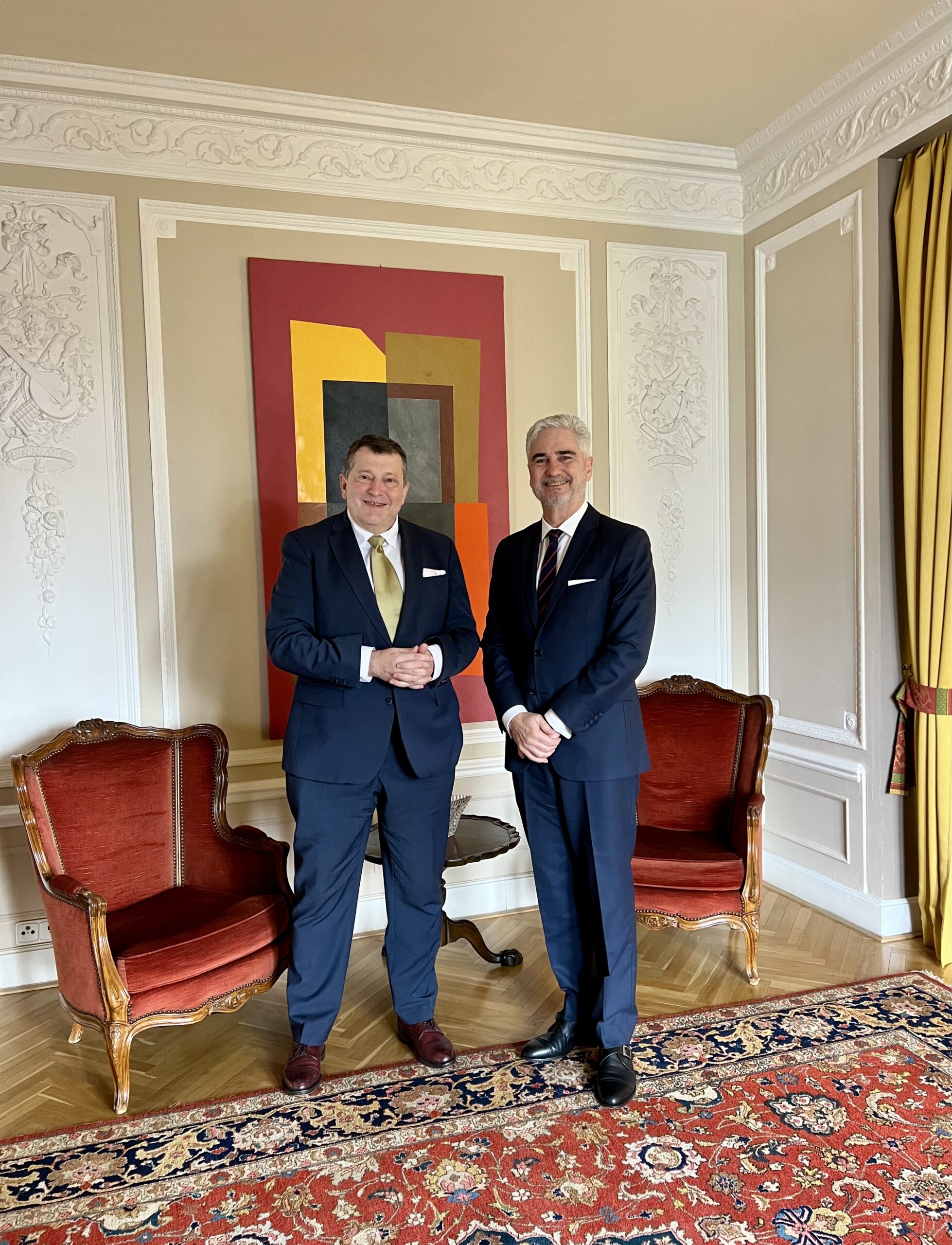
Interview with His Excellency Orlando Leite Ribeiro
We warmly invite you to an exclusive and highly topical conversation with His Excellency Orlando Leite Ribeiro, Ambassador of the Federative Republic of Brazil to the Czech Republic.
Ambassador Orlando Leite Ribeiro is a seasoned career diplomat with over 30 years of experience in the Brazilian Foreign Service. Trained as an economist, he has specialized in economic and trade affairs. Prior to his posting in Prague, he served as Secretary for Trade and International Relations at the Brazilian Ministry of Agriculture, where he played a key role in negotiating the agricultural chapter of the EU-Mercosur Agreement. With his extensive expertise in international trade relations and his pragmatic approach, he brings valuable insights into the current development of Brazilian-European relations.
Brazil is, with over 214 million inhabitants, the largest economy in Latin America, with a GDP of approximately 2.3 trillion US dollars, one of the cleanest energy mixes in the world, and vast natural resources. It is a strategically indispensable partner for Europe and the Czech Republic. Diplomatic relations between Brazil and the former Czechoslovakia date back to 1918 — Brazil was the first Latin American country to recognize the newly established Czechoslovakia. To this day, the numerous Czech-descended Brazilians form a vibrant bridge of friendship between the two nations.
Right now, this conversation with Ambassador Leite Ribeiro is particularly relevant and timely: In January 2026, the long-awaited EU-Mercosur Agreement was signed and is scheduled to enter into provisional application on 1 May 2026. It opens up enormous opportunities for expanding trade and investment between Europe and South America. At the same time, Brazil is a founding member of Mercosur (since 1991) and a key player in the BRICS group. In an increasingly multipolar world, Brazil positions itself as a pragmatic bridge-builder between the Global North and the Global South.
In times of geopolitical uncertainty, the search for resilient supply chains, sustainable development, energy and technology cooperation (for example in the defense sector with Embraer), as well as enhanced cultural and economic ties, Brazil offers stability, reliability, and immense potential — for the Czech Republic and the European Union alike.
In this interview, Ambassador Orlando Leite Ribeiro provides well-founded answers on Brazil’s domestic and foreign policy under President Lula da Silva, the opportunities for bilateral relations with the Czech Republic, the protection of the Amazon, Brazil’s role in BRICS and Mercosur, and the future of the partnership with Europe.
Welcome to the reading — a conversation that comes at exactly the right time.
Mr. Ambassador, what motivated you to join the diplomatic service, and which international experiences most shaped your view of Brazil’s role in the world?
I entered the diplomatic service guided by a combination of public vocation, intellectual curiosity, and a strong family tradition. My father, uncle, and grandfather were career diplomats; I am the fourth ambassador in the family—and perhaps the last, as my daughters have chosen different professional paths. I was raised in an environment where service to the State, the representation of Brazil abroad, and a sense of institutional responsibility were part of everyday life.
Over the course of my international career, I have developed a firm conviction that Brazil occupies a singular place in the global landscape. We are a country of continental scale, marked by diversity, endowed with abundant natural resources, and supported by a solid industrial base. Equally important is our ability to engage constructively with different centers of power. This combination enables Brazil to act as a bridge-builder and a reliable partner in addressing key issues on the international agenda.
What are your main political, economic, and cultural priorities during your mission to the Czech Republic?
My priorities in the Czech Republic center on strengthening economic and trade relations, fostering reciprocal investment flows, and deepening the cultural dimension as a foundation for trust and closer societal ties.
Bilateral trade offers considerable scope for expansion, both in agricultural commodities and in higher value-added industrial goods. A notable example is the acquisition of Embraer’s C-390 Millennium aircraft, which highlights the competitiveness of Brazil’s high-technology sector and opens avenues for further cooperation in strategic areas.
At the same time, I aim to broaden opportunities for Brazilian exporters, facilitate business linkages, support innovation initiatives, and encourage investment in both directions. In parallel, I consider it essential to reinforce Brazil’s cultural presence through public diplomacy, the promotion of the Portuguese language, academic exchanges, and cultural programming that enhances mutual understanding.
Such cultural capital not only brings societies closer, but also creates a more favorable environment for business, tourism, and long-term cooperation.
How do you assess the current state of bilateral relations between Brazil and the Czech Republic, and where do you see the greatest potential for cooperation?
Relations between Brazil and the Czech Republic have traditionally been cordial, grounded in mutual respect and the absence of significant divergences. That said, they remain below their full potential.
Both countries possess diversified industrial bases, strong engineering traditions, and robust capacities in applied research, supported by highly qualified technical workforces. There is clear potential for expanded cooperation in areas such as defense industries, energy, technology, healthcare, innovation, and university partnerships.
With enhanced institutional coordination and closer engagement between the business communities, there is ample room to expand trade, investment, and joint research and development initiatives.
Brazil recently experienced a period of intense political polarization during the government of Jair Bolsonaro. How do you analyze that period in light of Brazil’s democratic history?
Political polarization is not unique to Brazil; similar dynamics have been observed in the United States and across several European countries.
In Brazil’s case, polarization had already been intensifying prior to the Bolsonaro administration, deepened during that period, and, regrettably, continues to shape public life. It is nevertheless essential to emphasize that Brazil’s democratic system remains fully intact. Elections are free and regular, institutions operate within the constitutional framework, and freedoms of expression and of the press are firmly upheld.
Political debate can at times be intense, but it unfolds within the parameters of a functioning democracy.
Under the presidency of Luiz Inácio Lula da Silva, what are Brazil’s main domestic and foreign policy priorities today?
Under President Luiz Inácio Lula da Silva, the central objective is to accelerate economic growth with social inclusion, building on the positive trends observed in recent years. This entails deepening policies aimed at poverty reduction, job creation, and macroeconomic stability.
The approach seeks to reconcile fiscal responsibility with the revitalization of productive activity—expanding investment, strengthening social programs, and promoting strategic sectors such as energy transition, infrastructure, innovation, and sustainable agriculture.
Externally, the priority is to expand market access, attract investment, and reinforce Brazil’s presence in key global debates, guided by pragmatism and predictability.
Following political tensions and institutional challenges, how do you assess the resilience of Brazil’s democratic institutions today?
Democracy is a deeply rooted value in Brazilian society. The country’s experience under authoritarian rule left a lasting imprint, reinforcing the collective understanding that there is no viable alternative to a fully democratic system.
Much like the Czech Republic, which has also experienced periods of curtailed freedoms, Brazil places a high value on the rule of law, the separation of powers, and the protection of individual rights. Brazilian society is plural and dynamic, and this pluralism is expressed within a widely recognized and resilient democratic institutional framework.
As the largest economy in Latin America, what are the main challenges and opportunities facing Brazil’s economic agenda at this moment?
As Latin America’s largest economy, Brazil faces structural challenges related to productivity, workforce qualification, regulatory simplification, and the need to expand infrastructure investment.
At the same time, the country’s opportunities are considerable. Brazil benefits from a predominantly clean energy matrix, stands as a global agro-environmental powerhouse, possesses a large domestic market, and maintains an industrial sector with significant innovative capacity.
Advancing reforms that enhance competitiveness and legal certainty will be essential to unlocking these advantages and sustaining a more robust and durable growth trajectory.
The protection of the Amazon is central to international debate. How does Brazil balance economic development and environmental responsibility?
Reconciling economic development with environmental responsibility—particularly in the Amazon—requires a comprehensive approach that combines effective enforcement, the fight against illegal activities, and the promotion of sustainable economic alternatives.
Brazil is fully cognizant of its global environmental responsibilities, while also mindful of its sovereignty. Investment in the bioeconomy, science, innovation, and sustainable value chains is essential to generate income for local populations while preserving the forest.
The region’s development must be grounded in legality, social inclusion, and the rational use of natural resources.
Brazil is a key member of the BRICS group. What is the strategic importance of this bloc for Brazilian foreign policy?
BRICS serves as an important platform for Brazil to expand its international engagement and deepen coordination with major emerging economies.
The group enables the diversification of partnerships, the strengthening of financial mechanisms, and the advancement of discussions on global governance reform. For Brazil, it represents a space for pragmatic cooperation, focused on tangible outcomes in trade, investment, and development.
How do you view the prospects of the European Union–Mercosur agreement and its importance for Brazil?
The European Union–Mercosur agreement is of clear strategic importance for Brazil. I had the opportunity to contribute directly to the negotiation of the agricultural chapter during my tenure as Secretary for Trade and International Relations at the Ministry of Agriculture.
The understandings reached in July 2019 in that chapter remain broadly consistent with the recently concluded text. The agreement represents a balanced framework that takes into account the sensitivities of both sides while establishing a solid legal foundation for expanding trade.
It has the potential to significantly increase trade flows between the two blocs—in both agricultural and industrial goods—while also fostering investment and deeper integration into global value chains.
Brazil continues to face persistent social inequality. What are the priorities for promoting greater inclusion and sustainable development?
Reducing social inequality remains a structural priority. This requires expanding access to quality education, promoting formal employment, fostering entrepreneurship, and implementing public policies that reduce vulnerability while preserving macroeconomic stability.
Sustainable development must combine economic growth with social inclusion and a reduction in regional disparities. The key challenge is to ensure that gains in productivity and economic expansion translate into tangible improvements in people’s lives.
Brazil’s cultural diversity — with Indigenous, African, and European roots — is a defining characteristic. How does this pluralism shape national identity and cultural diplomacy?
Brazil’s cultural diversity—shaped by Indigenous, African, European, and numerous other influences—has given rise to a dynamic and open national identity.
This pluralism enhances Brazil’s ability to engage with a wide range of societies and cultures. In the realm of cultural diplomacy, it is expressed through music, literature, gastronomy, visual arts, and popular traditions that generate genuine interest and strengthen international ties.
Brazilian culture not only projects a positive image of the country, but also builds lasting bridges that facilitate academic, economic, and institutional cooperation.
Soccer occupies a central place in Brazilian culture. Icons such as Pelé and Neymar have projected Brazil globally. What role does soccer play as an instrument of soft power?
Football is one of Brazil’s most effective instruments of international projection. Icons such as Pelé, Zico, Romário, Ronaldinho, and Vini Jr. have helped shape a global image associated with talent, creativity, and excellence.
The sport transcends its athletic dimension: it brings societies closer together, engages younger generations, and fosters an immediate sense of connection with Brazil. As a form of soft power, it strengthens the country’s international image and opens avenues for broader cultural and institutional dialogue.
How does Brazil position itself geopolitically among the United States, China, the European Union, and other emerging powers?
Brazil’s foreign policy is guided by autonomy, pragmatism, and the diversification of partnerships. The country maintains significant relations with the United States, China, the European Union, and other emerging actors, seeking cooperation in trade, investment, science, technology, and global governance.
The objective is not to align exclusively with any one bloc, but to act in accordance with national interests, contributing to international stability, effective multilateralism, and negotiated solutions.
Considering your current position in Prague, how would you evaluate the success of your mission — economically, politically, and culturally?
The success of my mission in Prague will be measured by the depth and quality of bilateral relations at the conclusion of my tenure.
Economically, this means increased trade and investment; politically, more frequent and substantive dialogue, supported by consolidated cooperation mechanisms; culturally, a stronger Brazilian presence and closer academic and societal ties.
Beyond quantitative indicators, the broader objective is to leave behind a relationship that is more structured, more predictable, and more clearly oriented toward delivering tangible and lasting results for both countries.
__________________________________________________________________________________________
Recent posts
See AllPrague Forum Membership
Join us
Be part of building bridges and channels to engage all the international key voices and decision makers living in the Czech Republic.
Become a member