- Hans Weber
- February 16, 2026
Unstoppable Rise – Europe’s New Superpower?
Article by Robert A. Scherl
Unstoppable Rise – Europe’s New Superpower? Poland Prepares to Overtake Germany and the UK – Lessons Can Be Learned from the Poles and the Czechs
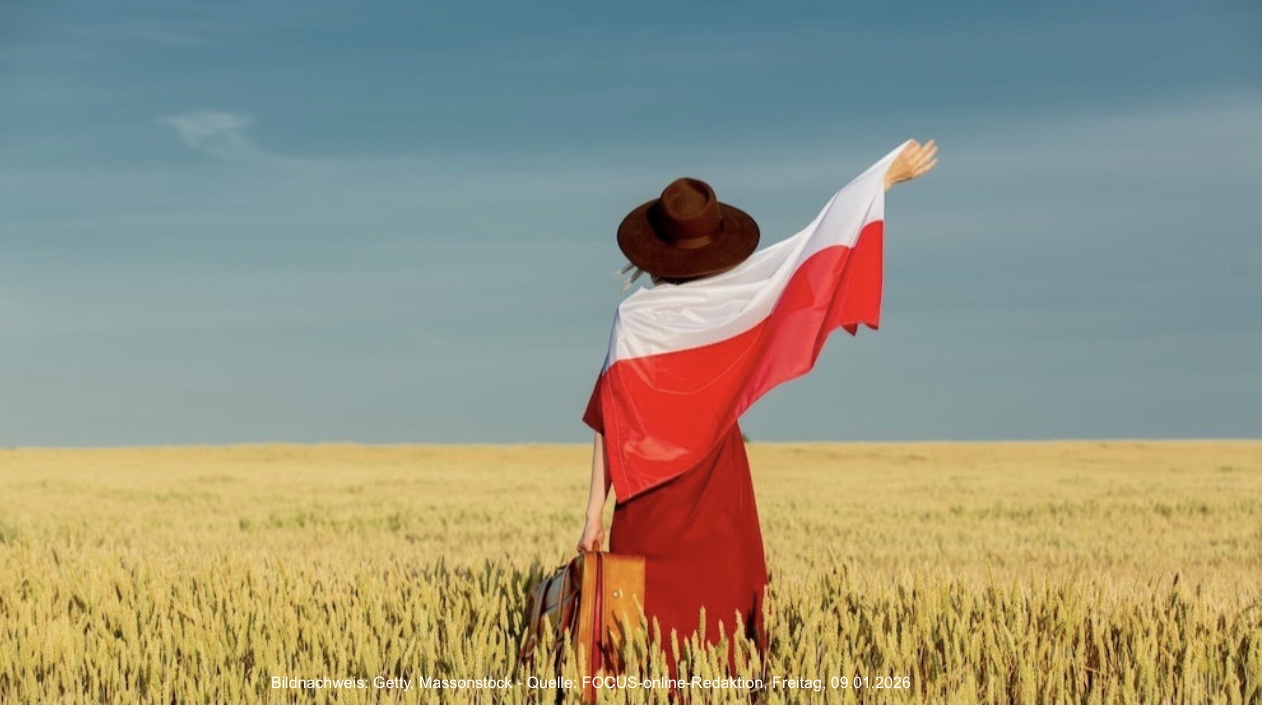
Poland’s economic rise is becoming increasingly noticeable in its European neighbors. The country is developing rapidly and could overtake Great Britain and Germany in just a few years.
(My note: The Czech Republic has already overtaken Germany in many areas!)
Just a few years ago, it would have been unthinkable that Poland would become a magnet for British emigrants. But according to the Telegraph, times have changed. Johnny Mercer, a British businessman who runs the construction company Polstrad in Poland, experienced this transformation firsthand.
When he advertised a marketing position in his company three months ago, he received 35 applications from Britons willing to relocate permanently to Poland – including one candidate with no connection to Poland who ultimately got the job.
Migration flows have reversed!
The traditional migration pattern between Poland and Great Britain has reversed.
According to official figures, only 7,000 Polish citizens moved to Great Britain in the first half of last year, while 25,000 Poles left the United Kingdom and returned to their homeland.
But it’s not just Poles returning. Since 2020, the number of Britons residing in Poland has almost doubled, from 113,000 to 185,000.
(My note: many of these are Poles who lived in Great Britain for a long time and acquired British citizenship there.)
According to “Polskie Radio“, Germany also now has a negative migration balance with its eastern neighbor.
(My note: I completely agree.)
Economic growth is crucial.
Poland’s economic success is one of the main reasons for this trend. Jadwiga Emilewicz, former Deputy Prime Minister of Poland, describes the current development as a “golden era of the Polish economy.”
Indeed, the gross domestic product (GDP) per capita has increased from 42.7 percent of the British level in 2000 to an impressive 85.9 percent.
According to forecasts, the average household income in Poland could surpass that of the UK by 2031. Warsaw is also steadily approaching the level of the German economy.
(My note: If the Czech Republic had a similarly strong arms and/or defense industry as present-day Poland, then economic growth in Poland would be correspondingly weaker.)
High quality of life is a major draw.
(My note: When you compare the “cityscape” à la (not Allah😑) Merz with Poland, not to mention the economic situation in Germany, then this is self-evident.)
Many foreigners are also impressed by the quality of life.
(My note: When you compare the “cityscape” à la (not Allah😑) Merz with Poland, not to mention the economic situation in Germany, then this is self-evident.)
Many foreigners are also impressed by the quality of life.
Real estate is significantly cheaper than in Great Britain and Germany.
Safety is also a factor. A British woman told the Telegraph that she had been the victim of several burglaries in London, while she felt safe enough to walk the streets alone at night in Warsaw.
(My note: This also applies to the Czech Republic and the imperial city of Prague, and to almost all Eastern European countries! Unlike in Germany, I have never felt unsafe in an Eastern European country.)
Source: FOCUS online editorial team, Friday, January 9, 2026
Berlin: Crime Hotspot: More Crimes in the German Capital Than in All of Poland
Poland has ten times the population of the German capital, yet Berlin has significantly more crimes than Germany’s eastern neighbor. What could be the reason for this? The truth is likely to be particularly uncomfortable for left-leaning multiculturalists.
In 2024, Poland, with its approximately 37 million inhabitants, recorded a total of 440,269 criminal investigations initiated by the authorities. According to official data, Berlin saw 539,049 offenses that year. This equates to more than 14,200 offenses per 100,000 inhabitants in Berlin, compared to just under 1,200 offenses per 100,000 inhabitants in Poland.
(My note: I can easily imagine that the number of unreported crimes in Berlin—with around 80 stabbings, shootings with firearms, gang rapes, and so much more occurring daily—is significantly higher than in Poland. In Germany, many crimes are no longer reported, and the statistics, including the unemployment rate, are heavily manipulated for political and ideological reasons!)
Poland has fewer of these problems. Of the approximately 2.1 million foreigners in the country, almost 1.8 million were Ukrainians and Belarusians. Asylum seekers from Africa, the Middle East, and West Asia are rare. This can be assumed to be a significant explanation for the large differences, not only between Berlin and Poland, but also between Germany and its eastern neighbor.
Source: Report 24, February 14, 2026
The economies of the EU are sluggish to varying degrees, but one of its larger members can boast positive figures: Poland. With GDP growth of almost three percent in 2024, the country is ahead of the EU-wide growth rate of one percent and ahead of the Union’s two largest economies, France and Germany. France has a rate of 1.2 percent, while Germany even suffered a decline of minus 0.2 percent.
The economies of the EU are sluggish to varying degrees, but one of its larger members can boast positive figures: Poland. The signs for the current year are also optimistic: Poland recorded growth of 0.8 percent in the second quarter, the fifth-best rate in the EU. Growth of around 3.3 percent is forecast for this year, and it could reach three percent next year. And this success is no overnight success: Since joining the EU in 2004, average annual growth has been almost four percent.
Over the next 20 years, nuclear energy is intended to replace coal alongside gas and renewable energies. So far, however, Poland has no nuclear power plants. Construction of the first nuclear power plant in Słajszewo, near Gdańsk, is scheduled to begin in 2028 and be completed ten years later. A second plant is planned to be built starting in 2032.
My comment: Germany, the export champion of morality and ideology, destroyed its nuclear power plants, yet currently imports a great deal of electricity from France, and a large portion of its current electricity generation is based on gas-fired power plants. Facts about nuclear power plant construction in China (as of 2025/2026): Record number of construction sites: With 27 to 30 reactors under construction (as of the end of 2025), China has the most ongoing construction projects worldwide.
Source: Deutsche Welle, October 20, 2025, Author: Arthur Sullivan
Finance Minister: Złoty remains better than the Euro in uncertain times
January 29, 2026, 11:51 AM
Poland’s Finance Minister Andrzej Domański does not currently consider joining the Eurozone to be sensible and advocates for retaining the złoty. The national currency gives the Polish economy more flexibility in times of global uncertainty, Domański said in an interview with Euronews at the European Parliament.
(My note: The majority of Czechs, as well as the Czech government and National Bank, currently have absolutely no interest in the “introduction” of the euro.)
Source: Polish Radio, January 29, 2026, 11:51 AM
Recent posts
See AllPrague Forum Membership
Join us
Be part of building bridges and channels to engage all the international key voices and decision makers living in the Czech Republic.
Become a member