- Hans Weber
- October 6, 2026
Slovakia and Czechia: A Friendship Forged by History
Slovak State Reception in Prague Celebrates Constitution, Armed Forces and an Extraordinary Relationship
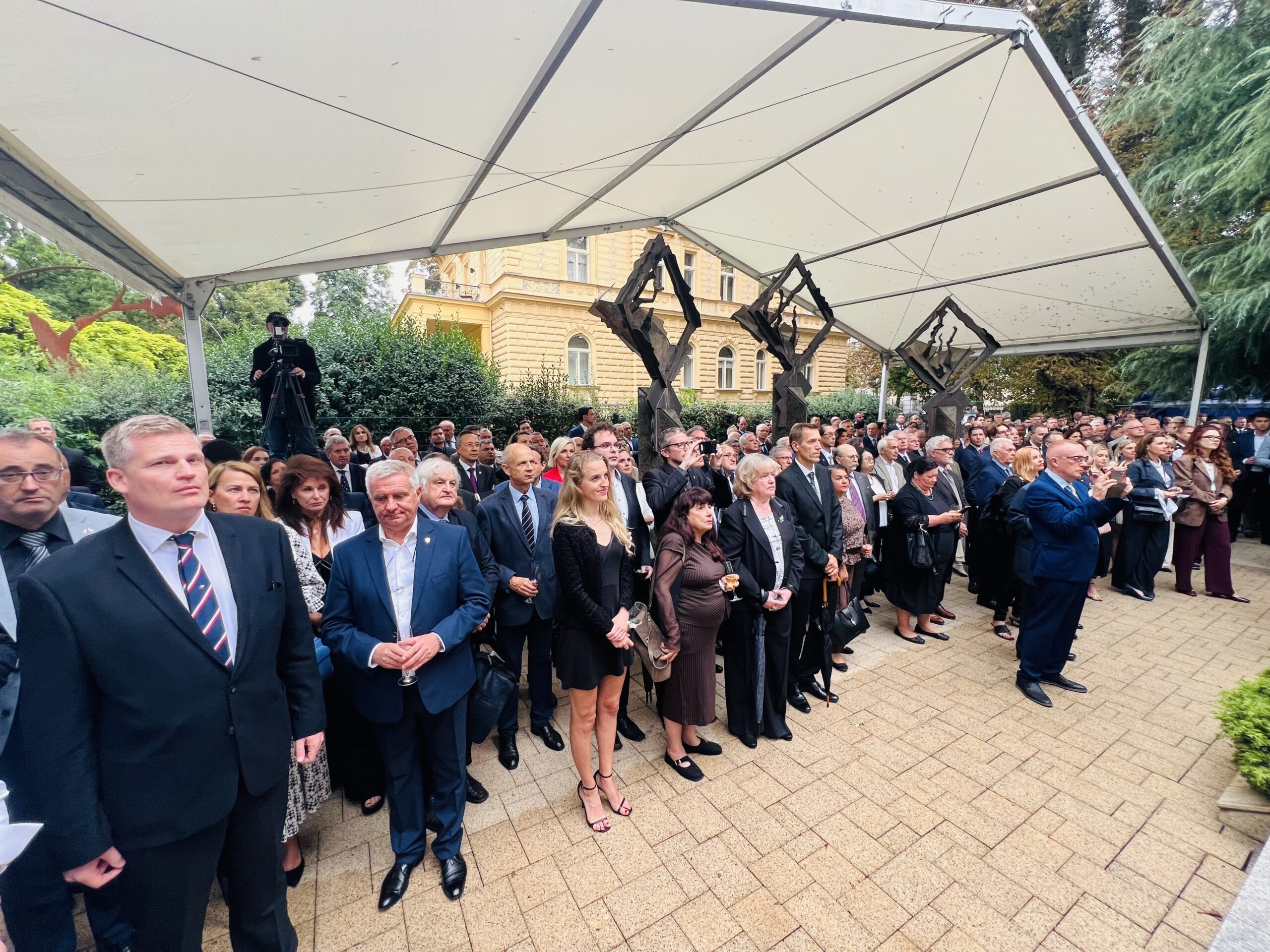
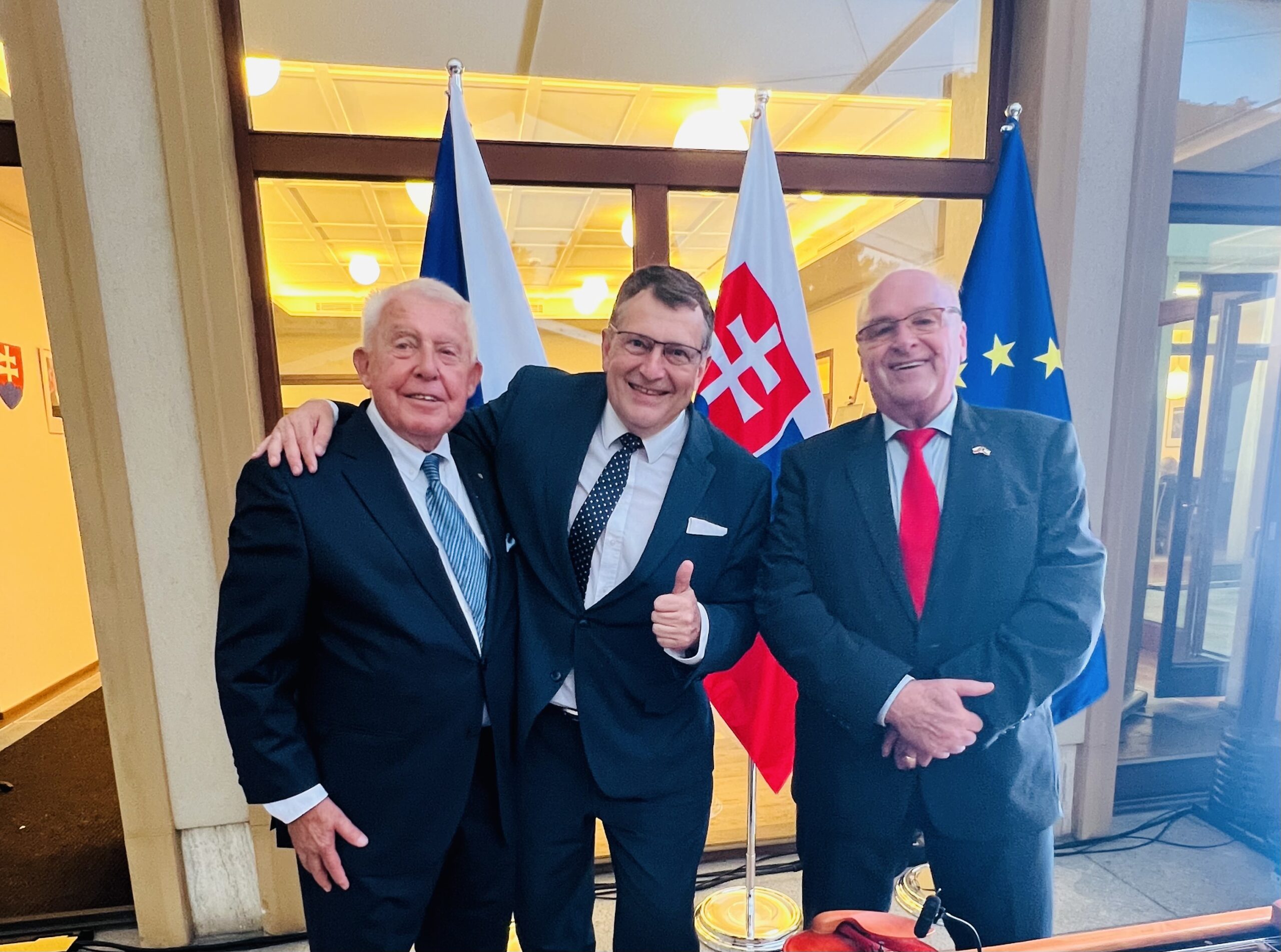
On Wednesday, 9 September 2026, the Embassy of the Slovak Republic in Prague’s diplomatic district of Bubeneč once again became the venue for one of the largest and most distinguished national-day receptions on Prague’s diplomatic calendar.
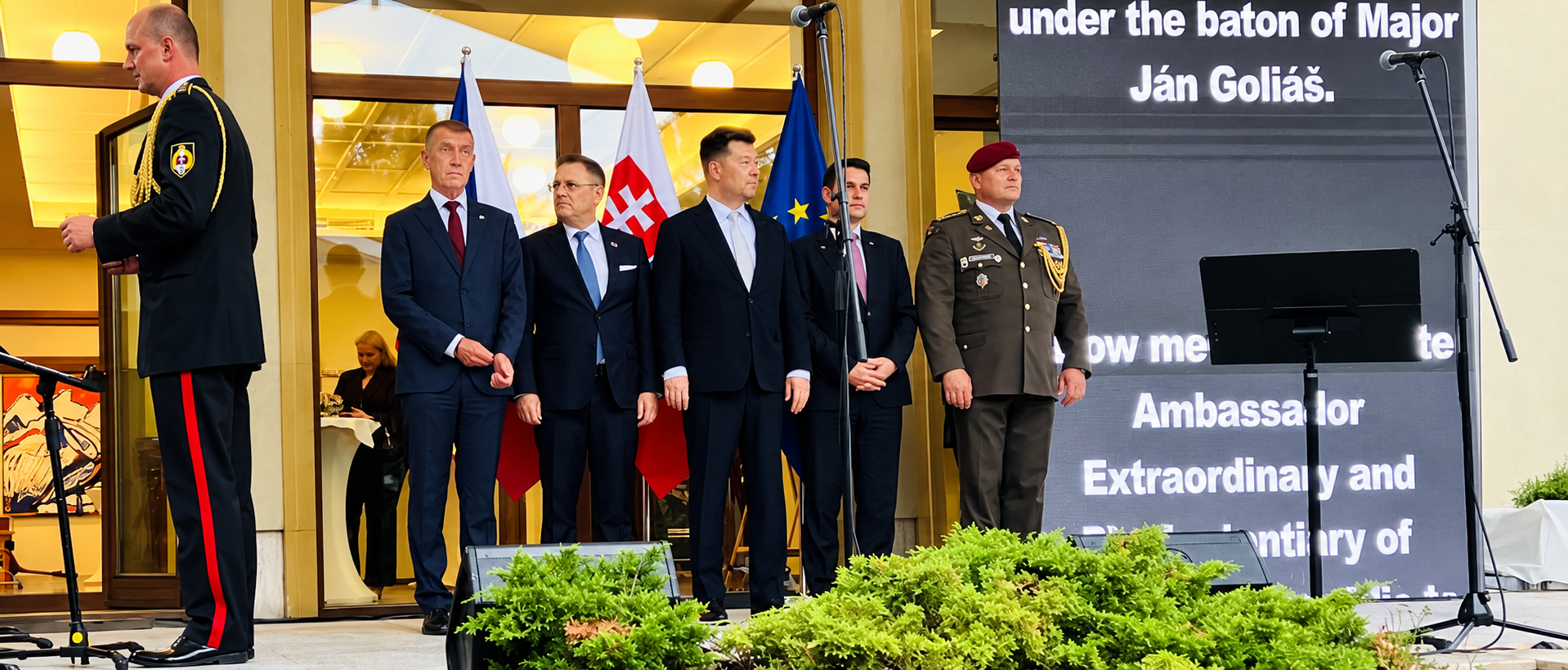
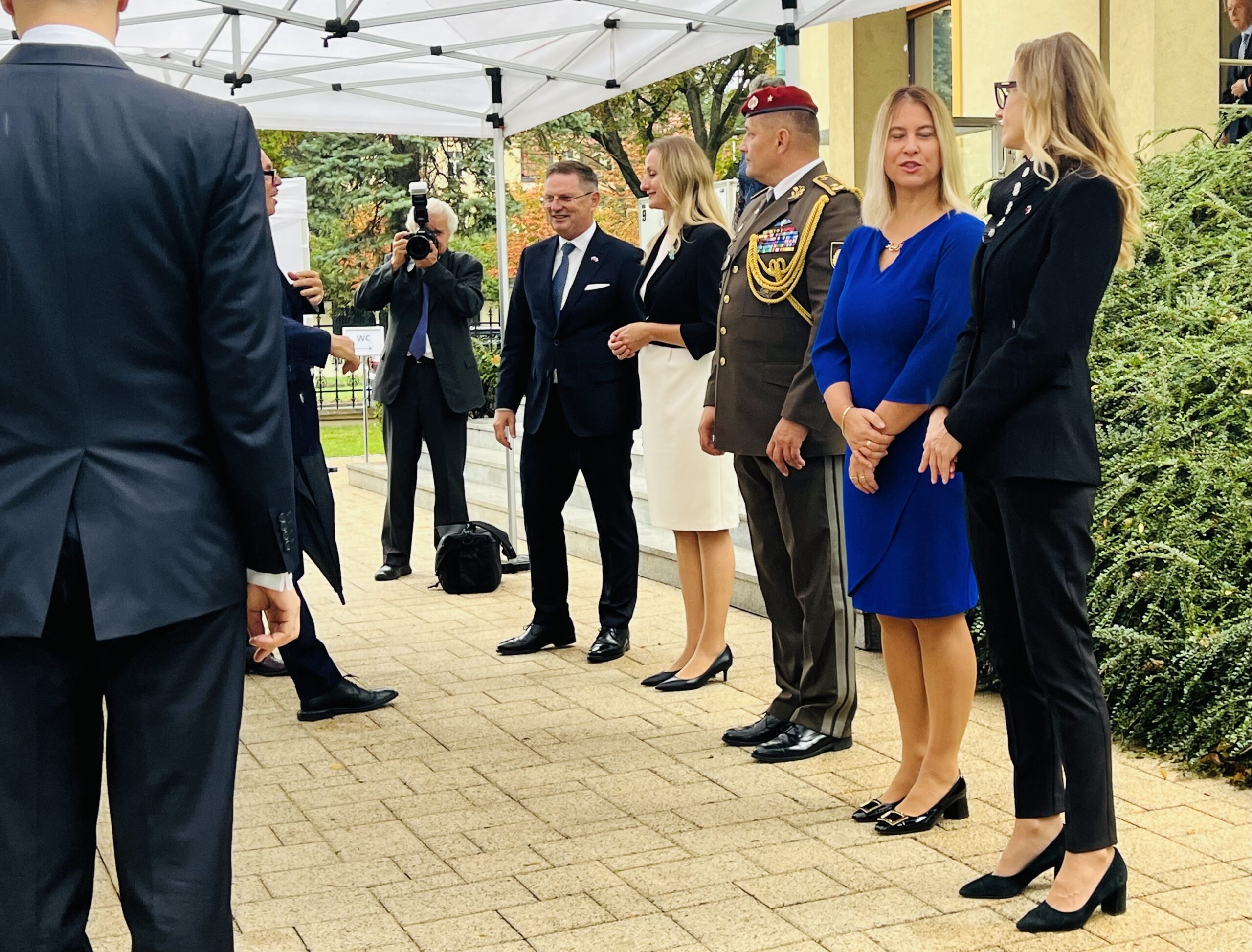
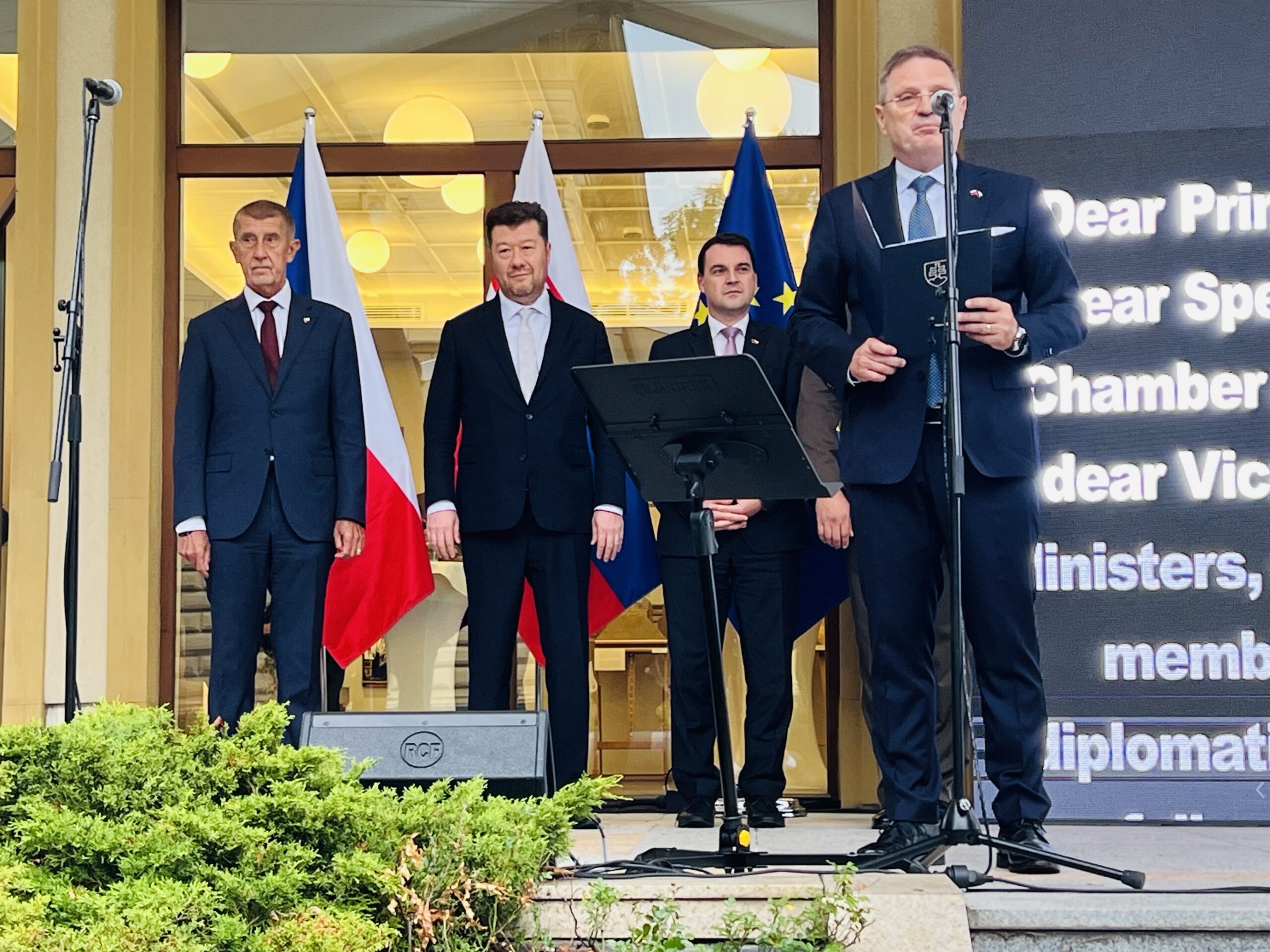
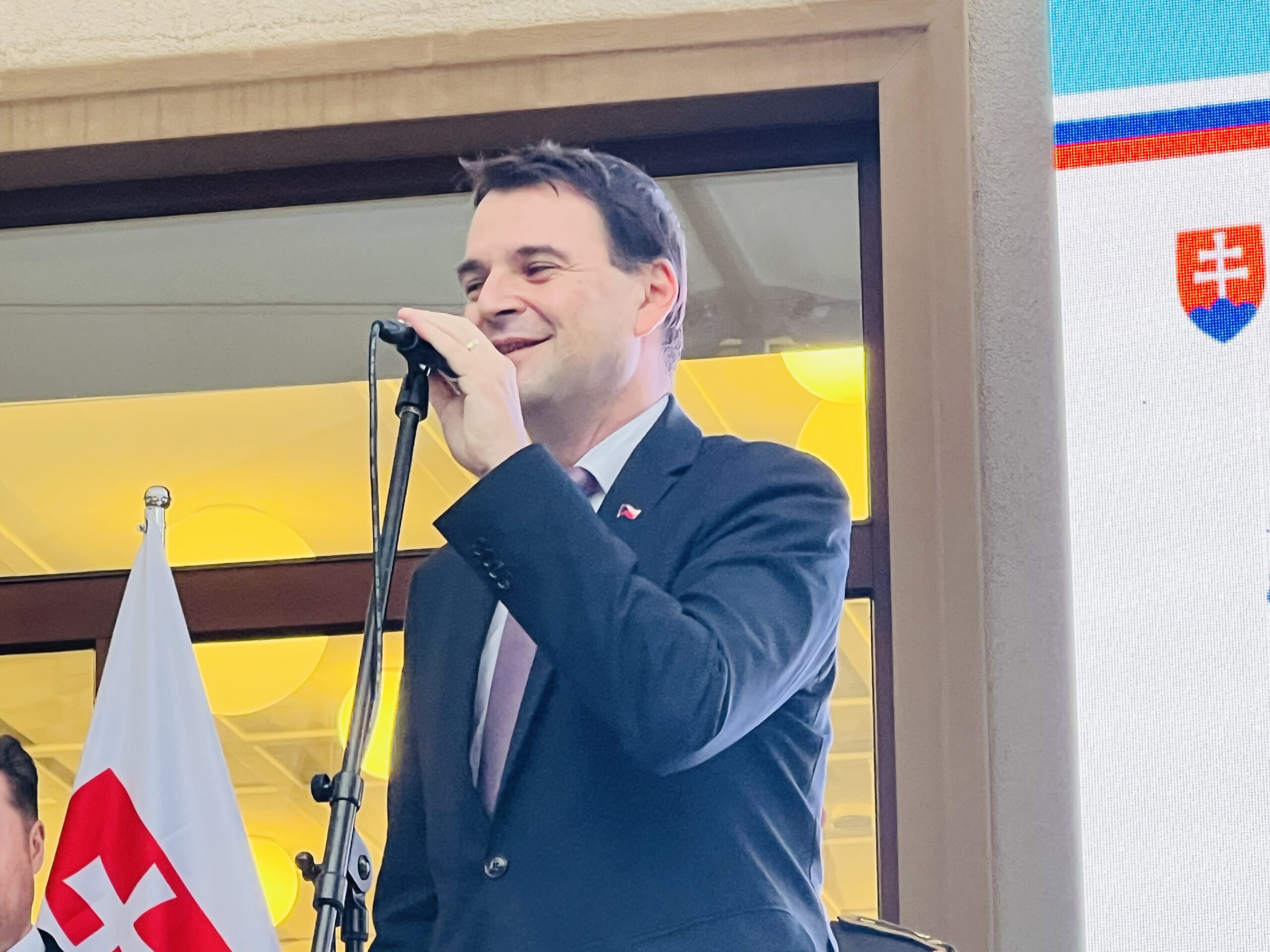
H.E. Martin Muránsky, Ambassador of the Slovak Republic to the Czech Republic, together with his wife Jana Muránska, welcomed representatives of Czech and Slovak politics, diplomacy, the armed forces, business, culture and public life to celebrate two important Slovak occasions: the Constitution Day of the Slovak Republic and the Day of the Armed Forces of the Slovak Republic.
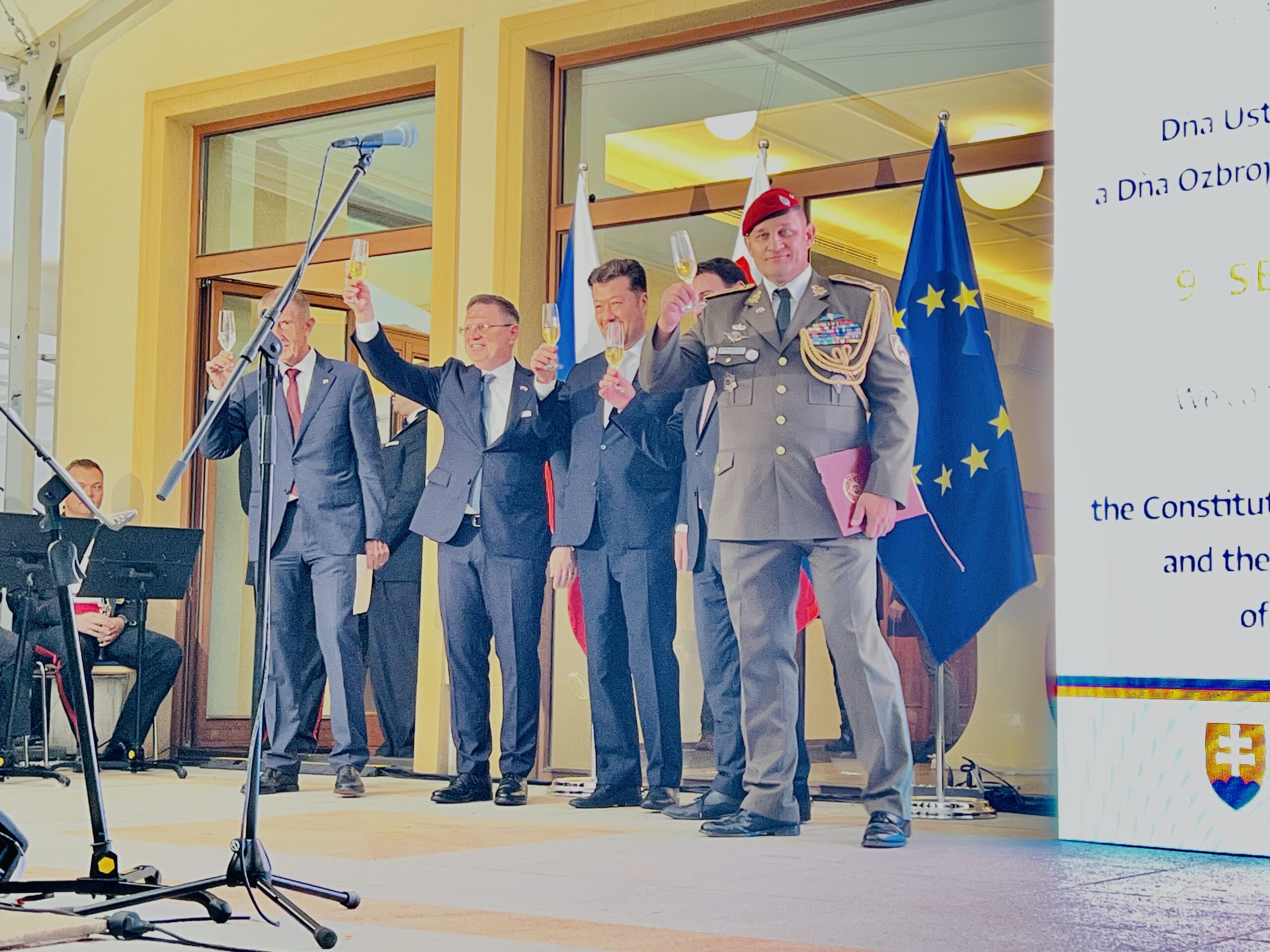
The reception brought together some of the highest representatives of the Czech state. Among the principal guests were Czech Prime Minister Andrej Babiš, President of the Chamber of Deputies Tomio Okamura, Deputy Prime Minister and Foreign Minister Petr Macinka, as well as numerous members of parliament, ministers, diplomats, senior military officers and representatives of Czech and Slovak public life. The Slovak Embassy also listed Deputy Speaker Patrik Nacher, Foreign Affairs Committee Chairman Radek Vondráček, Culture Minister Ota Klempíř, Justice Minister Jeroným Tejc, Sports Minister Boris Šťastný, Government Commissioner Filip Turek and Chief of the General Staff of the Czech Armed Forces Miroslav Hlaváč among the prominent guests. Former First Lady and former Czech Ambassador to Slovakia Livia Klausová and former Foreign Minister Cyril Svoboda were also present.
Representatives of the churches, cultural personalities and many members of Prague’s diplomatic community completed an impressive guest list. Among the familiar faces from Czech cultural life was the well-known musician Felix Slováček.
As so often at Slovak receptions in Prague, however, this was much more than a diplomatic ceremony.
It was almost a family gathering.
Martin Muránsky – philosopher, academic and diplomat
Ambassador Martin Muránsky is an unusual representative of his country in the best sense of the word. He did not follow the traditional diplomat career path.
Muránsky is a philosopher and academic. Before becoming ambassador in Prague in 2025, he held senior positions at the Institute of Philosophy of the Slovak Academy of Sciences and at the educational and publishing institute ASA – Analyses, Strategies, Alternatives. He was professor of practical philosophy at Comenius University in Bratislava, headed research on normativity and human rights at the Slovak Academy of Sciences, and worked as a consultant to the Slovak government on international human-rights questions.
From 2014 to 2020, he was a member of the advisory body of the Slovak Prime Minister and for many years worked in the environment of the National Council of the Slovak Republic. He also managed the Slovak-Czech political education programme “Academy of Social Democracy”.
His professional biography therefore explains something that was evident in his speech in Prague: Muránsky approaches diplomacy not only from the perspective of daily politics, but also through questions of statehood, sovereignty, history and political philosophy.
His wife Jana Muránska is herself highly active in Prague’s diplomatic community. She serves as president of the Diplomatic Spouses Association Prague, which this year distributed CZK 1.32 million in grants to sixteen Czech charitable organizations.
Constitution, sovereignty – and cooperation
At the beginning of his address, Ambassador Muránsky recalled the adoption of the Slovak Constitution on 1 September 1992, several months before the independent Slovak Republic came into existence on 1 January 1993.
The constitution had been approved by the Slovak National Council on 1 September 1992. It entered into force on 1 October of that year, with certain provisions taking effect only after the dissolution of the federation on 1 January 1993.
Muránsky linked sovereignty directly with responsibility and cooperation.
For him, sovereignty does not mean isolation.
That thought was an important theme of the evening.
The ambassador pointed in particular to the renewed joint meetings of the Czech and Slovak governments under Prime Ministers Andrej Babiš and Robert Fico. The ninth joint government meeting took place on 31 March 2026 at Nová Horka in the Czech Republic and resulted in a memorandum intended to deepen cooperation between both governments, ranging from energy security and agriculture to European policy.
He also highlighted cooperation between Presidents Petr Pavel and Peter Pellegrini, between the two parliaments and within regional formats such as the Visegrád Group.
The reception thus looked simultaneously backwards and forwards: towards history, but also towards a renewed Central European partnership.
Were Czechs and Slovaks really one nation?
The extraordinary relationship between the Czech Republic and Slovakia cannot be understood without going much further back than the creation of Czechoslovakia in 1918.
Czechs and Slovaks are closely related West Slavic peoples. Their languages are mutually understandable to a remarkable degree, their cultures are closely related, and both were influenced by the medieval legacy of Great Moravia.
But historically they did not develop for centuries as one political nation.
That distinction is important.
The Czech lands – principally Bohemia and Moravia – formed historic crown lands that eventually became part of the Habsburg monarchy and were administered largely from Vienna.
The territory of present-day Slovakia, by contrast, belonged for centuries to the Kingdom of Hungary. Slovak political and cultural development therefore took place in a very different administrative and political environment.
By the nineteenth century, these differences were considerable. The Czech lands had become among the most industrialised regions of the Habsburg Empire and possessed a comparatively developed Czech-speaking bourgeoisie, education system and political infrastructure.
Slovaks lived predominantly within the Hungarian half of the monarchy, where the process of Magyarisation placed considerable pressure on Slovak language, education and national institutions.
The two peoples were relatives – but relatives who had grown up in different houses.
Scholarly research into the ideology of “Czechoslovakism” notes precisely this problem: after 1918 the official concept of a single “Czechoslovak nation” attempted to unite two closely related but historically and socially distinct nations whose development inside Austria-Hungary had been very different.
1848 – an early chapter of Slovak national emancipation
This history also explains why the Slovak Armed Forces celebrate their day on 22 September.
During the revolutions of 1848, Slovak leaders including Ľudovít Štúr, Jozef Miloslav Hurban and Michal Miloslav Hodža demanded greater national rights.
Slovak volunteers crossed from Moravia into the Kingdom of Hungary. On 22 September 1848, near Brezová pod Bradlom, they achieved their first military victory.
That event became a symbol of the Slovak struggle for political and national self-determination and today forms the historical basis of the Day of the Armed Forces of the Slovak Republic.
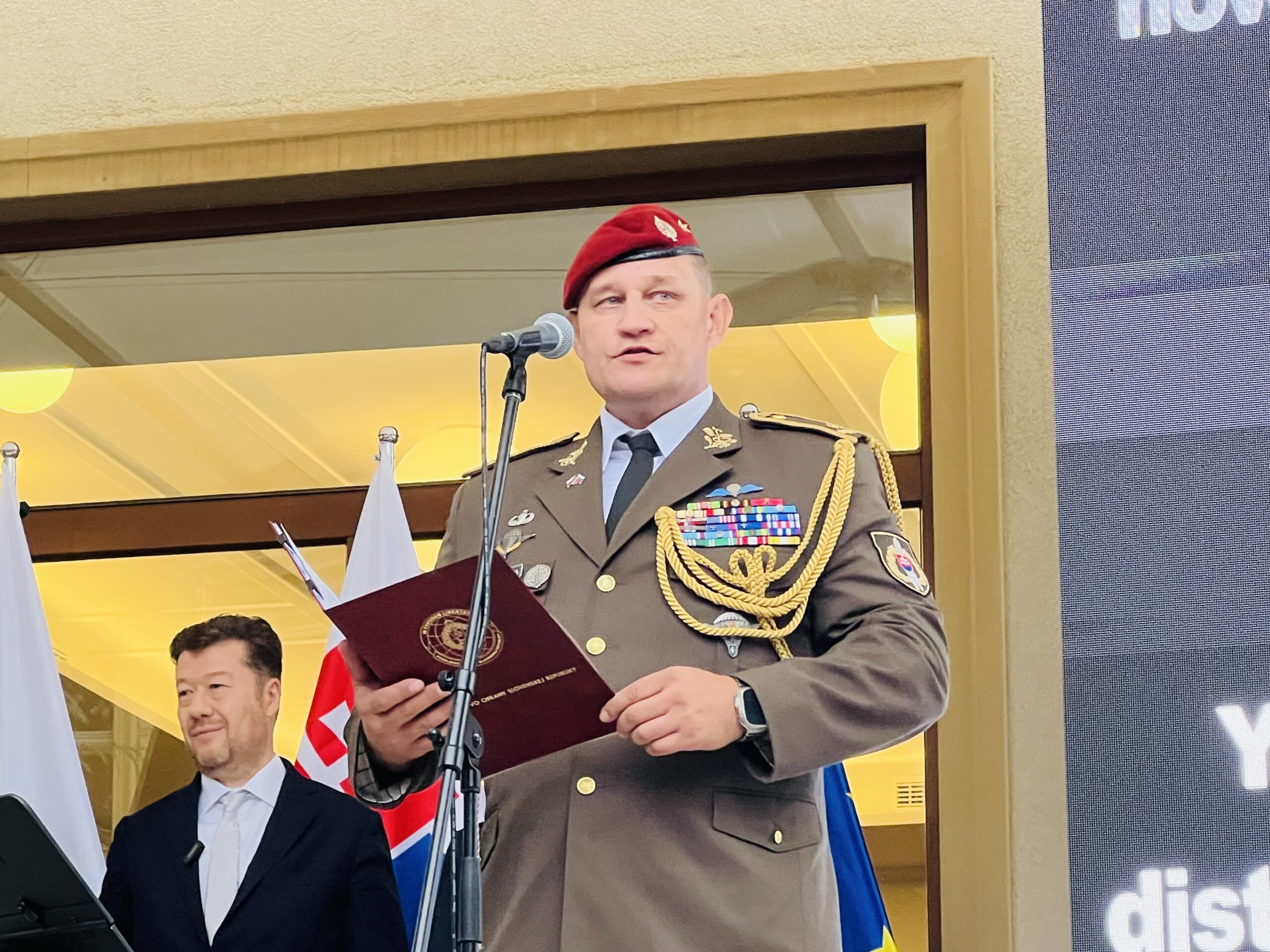
This history was recalled at the reception by Brigadier General Branislav Benka, Defence Attaché of the Slovak Republic in the Czech Republic.
In his address, Benka traced the military tradition of modern Slovakia back to the revolutionary years of 1848 and 1849 and emphasised that freedom and sovereignty cannot simply be proclaimed; they also have to be protected.
He linked this nineteenth-century legacy to the service of today’s Slovak soldiers within NATO and the European security system.
1918: a marriage of affection – or political necessity?
When Austria-Hungary collapsed at the end of the First World War, the Czech and Slovak national movements faced a historic opportunity.
The creation of Czechoslovakia was neither simply a romantic “love marriage” nor merely a cold geopolitical construction imposed by the victorious Allies.
It was both idealism and political calculation.
For Tomáš Garrigue Masaryk, Edvard Beneš and the Slovak statesman and soldier Milan Rastislav Štefánik, a common Czechoslovak state offered clear strategic advantages.
For the Czechs, it strengthened the demographic and political case for establishing an independent state that could also retain the historic borders of Bohemia and Moravia despite their large German-speaking population.
For Slovaks, union with the Czechs offered a way out of the Kingdom of Hungary and protection for a still relatively young national political and educational infrastructure.
Masaryk and Beneš successfully persuaded the Western Allies to recognise the Czechoslovak project during the final phase of the First World War.
On 28 October 1918, an independent Czechoslovak state was proclaimed in Prague.
Two days later, on 30 October 1918, Slovak political representatives assembled at Turčiansky Svätý Martin and declared Slovakia’s separation from Hungary and its union with the Czech lands in the new Czechoslovak state.
Thus the common state was not simply created by foreign powers.
It also had significant support among Czech and Slovak political elites.
Yet there was an important ambiguity from the beginning.
The new republic officially promoted the concept of one “Czechoslovak nation” with Czech and Slovak branches. Politically this was useful, not least because it strengthened the position of Czechs and Slovaks numerically in a multinational state containing large German and Hungarian minorities.
Culturally and historically, however, Slovaks increasingly insisted that they were not merely a branch of one Czechoslovak nation, but a nation in their own right.
The question would accompany Czechoslovakia throughout much of its existence.
Munich, 1938 and the end of the First Republic
The first Czechoslovak Republic survived for twenty years.
In September 1938, the Munich Agreement forced Czechoslovakia to surrender the predominantly German-speaking Sudeten territories to Nazi Germany.
The state was fatally weakened.
Slovakia obtained extensive autonomy in October 1938. At the same time, the First Vienna Award forced Slovakia to cede substantial southern territories with large Hungarian populations to Hungary.
Then, in March 1939, Czechoslovakia ceased to exist.
The Czech lands became the German Protectorate of Bohemia and Moravia, while a formally independent Slovak Republic was created under President Jozef Tiso. In reality, it existed under overwhelming German political and military influence.
Thus the common state created in 1918 was broken apart by the dramatic changes imposed on Central Europe by Nazi Germany.
Reunification in 1945 – and communist rule from 1948
After the defeat of Nazi Germany in 1945, Czechoslovakia was restored.
The restored republic was, however, fundamentally different from that of 1918.
The Holocaust had destroyed much of the country’s Jewish population. The post-war expulsion of most Germans radically altered the ethnic composition of the Czech lands. The political balance also shifted strongly towards the Soviet Union.
In February 1948, the Communist Party seized power.
Czechoslovakia became part of the Soviet-dominated Eastern Bloc.
After the suppression of the Prague Spring by Warsaw Pact troops in 1968, the state was formally reorganised as a federation consisting of the Czech Socialist Republic and the Slovak Socialist Republic.
That federal structure would later prove crucial.
It institutionalised the existence of two national republics inside one state.
1989: freedom returns
The Velvet Revolution of November 1989 brought communist rule to an end.
Václav Havel became president, democracy returned and Czechs and Slovaks suddenly had to answer a question that four decades of communist rule had largely frozen rather than resolved:
What exactly should their common state now be?
For many citizens the answer remained Czechoslovakia.
For others, particularly in Slovakia, genuine national sovereignty required considerably more autonomy.
Political negotiations following the elections of 1992 ultimately led Czech Prime Minister Václav Klaus and Slovak Prime Minister Vladimír Mečiar towards separation.
On 1 January 1993, Czechoslovakia ceased to exist and two independent states were born: the Czech Republic and the Slovak Republic.
Remarkably, there was no violence.
No armies confronted each other.
No borders were fought over.
No ethnic cleansing accompanied the change.
The “Velvet Divorce” became one of the rare examples in modern European history of the peaceful dissolution of a multinational state.
And perhaps the greatest paradox is that separation did not destroy Czech-Slovak friendship.
It may even have strengthened it.
“We still are family”
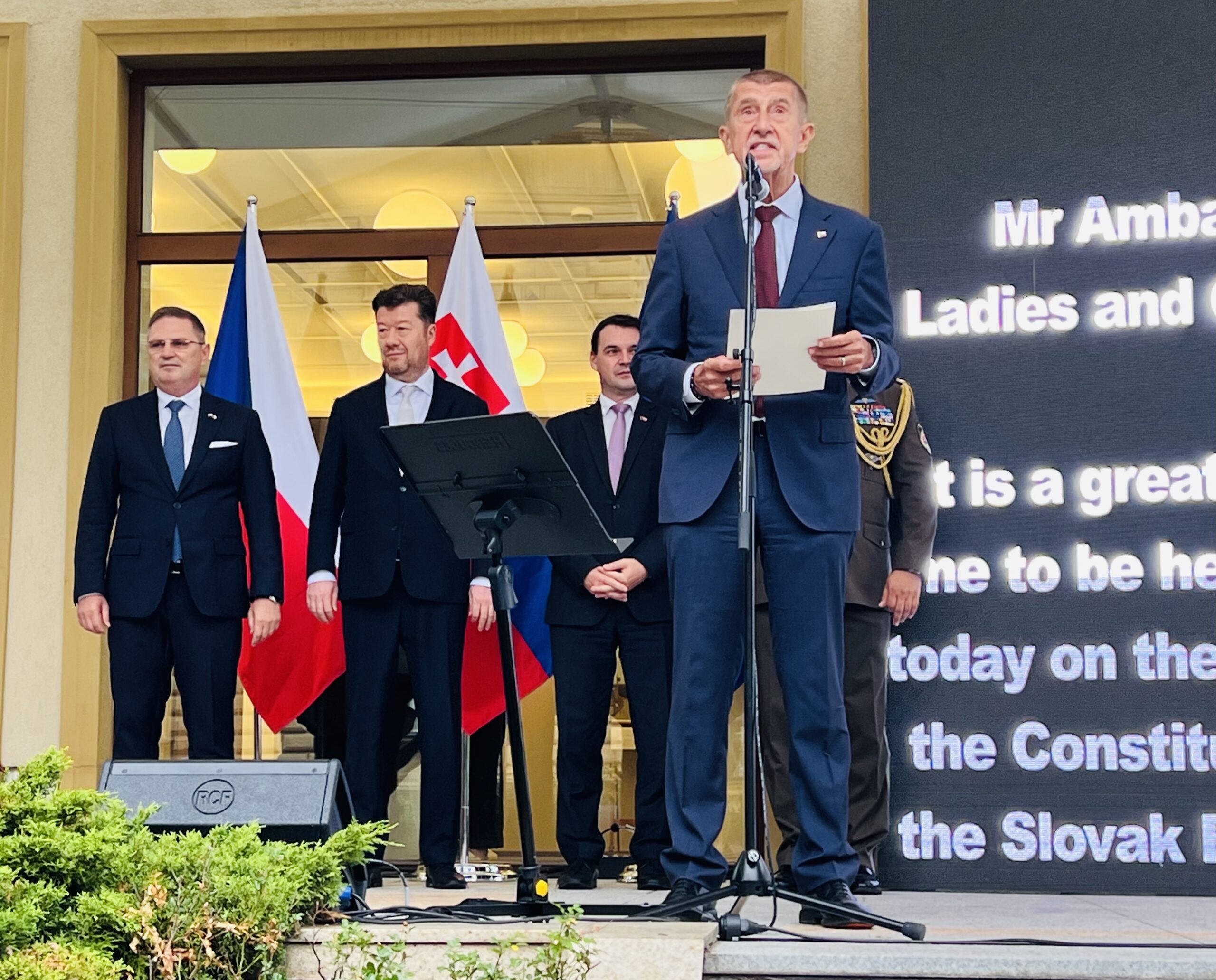
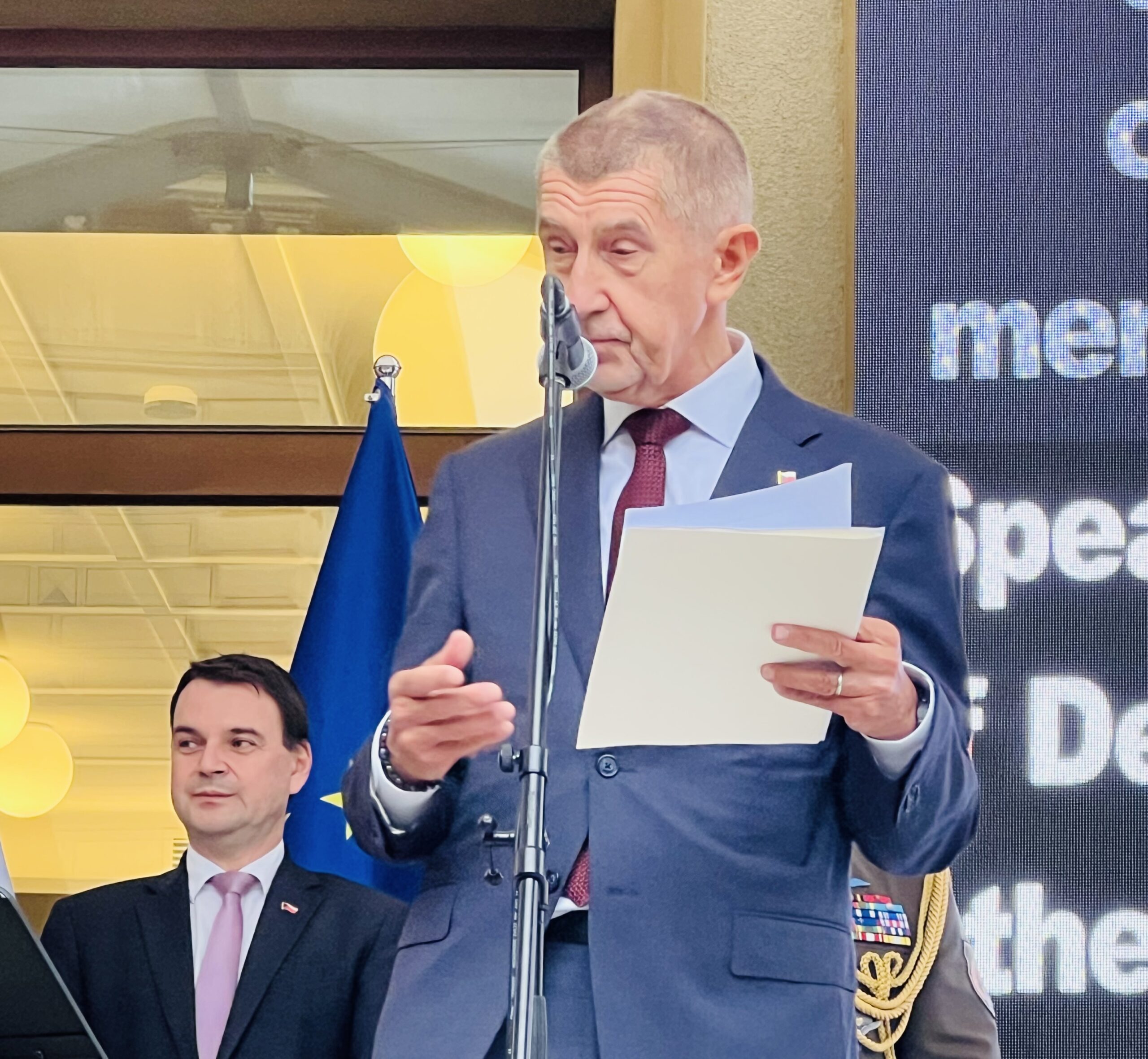
That was precisely the message of Czech Prime Minister Andrej Babiš.
His presence carried particular symbolism.
Babiš was born in Bratislava on 2 September 1954, studied at the University of Economics in Bratislava, and spent much of his early professional life in Slovakia before establishing Agrofert in Prague in 1993.
A Bratislava-born politician standing as Prime Minister of the Czech Republic at the Slovak Embassy therefore embodied something characteristic of the two countries: national borders exist, but thousands of biographies still cross them.
In his speech, Babiš described Slovakia as much more than an ordinary neighboring country.
Czechs and Slovaks, he said, share history, cultural proximity and family relationships that are virtually unique in Europe.
His most memorable metaphor was simple.
For a long time, Czechs and Slovaks had grown up together. Today they each have their own house and make their own decisions.
But they are still family.
The Prime Minister also pointed to practical cooperation. Slovakia is one of the Czech Republic’s most important trading partners, while both countries cooperate on transport, energy, European policy, security and defence.
In defence, Babiš highlighted cooperation in airspace protection, air defence, cyber security, critical infrastructure, training and new military technologies.
At the end of his address he returned to the family image.
For Czechs, he suggested, Slovakia’s constitutional holiday is not simply the birthday of a state on the other side of the Morava River.
It is the birthday of someone close.
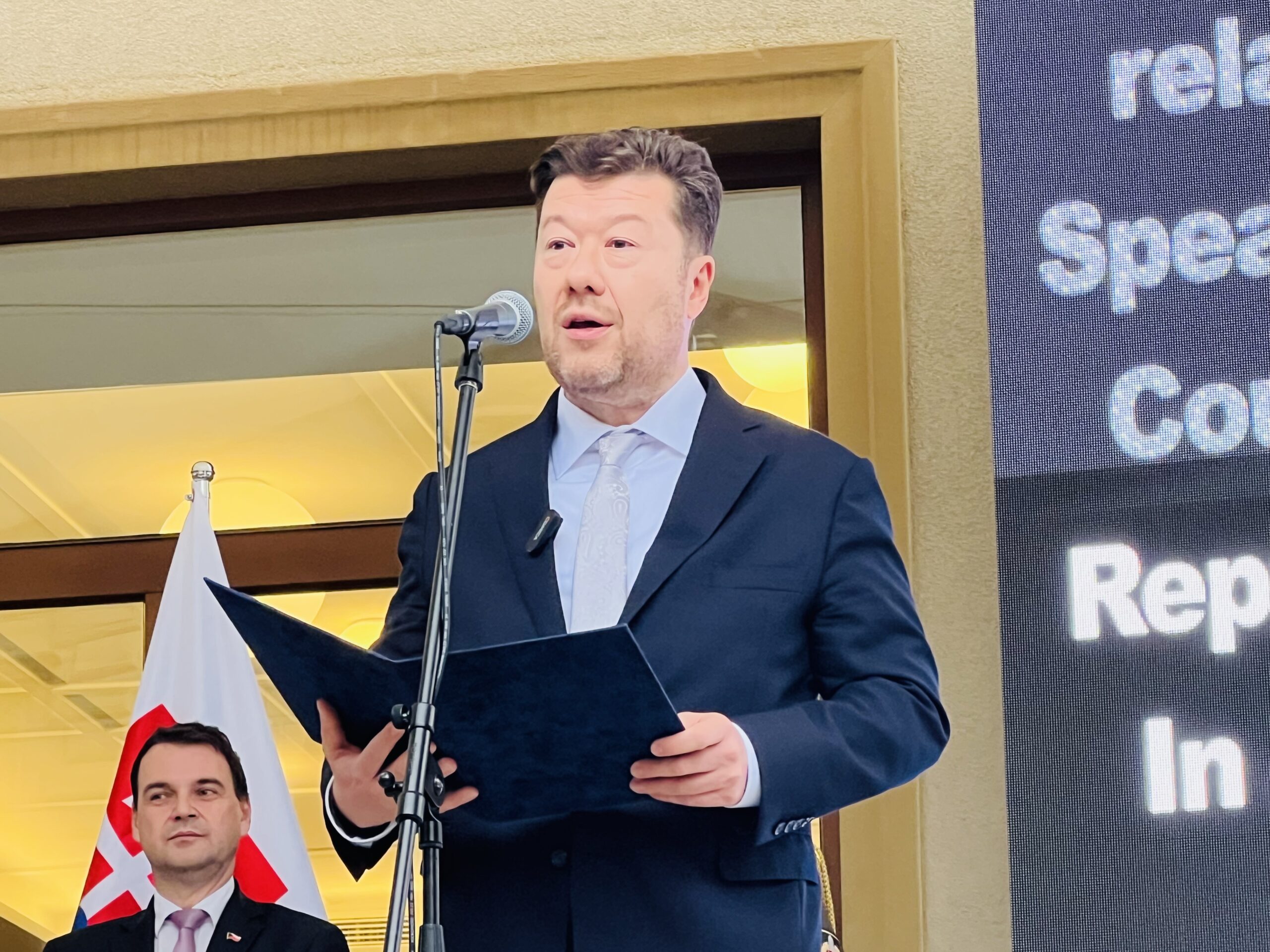
Tomio Okamura: “Slovaks, I love you”
The President of the Czech Chamber of Deputies, Tomio Okamura, also placed history at the centre of his address.
He described Slovaks as the closest nation to the Czechs and emphasised language, culture, family ties and the common experience of much of the twentieth century.
Particularly important, he said, was the manner in which Czechoslovakia had separated: peacefully, with dignity and mutual respect.
According to Okamura, this showed the world that even a fundamental historical change can take place while friendship survives.
He also highlighted his cooperation with the President of the Slovak National Council, Richard Raši, including parliamentary exchanges and a new award celebrating Czech-Slovak mutuality.
Then came a very personal conclusion.
“Slováci, mám vás rád.”
“Slovaks, I love you.”
He concluded by wishing long life to the Slovak Republic, the Czech Republic and Czech-Slovak friendship.
Few phrases could have summed up the atmosphere of the evening more effectively.
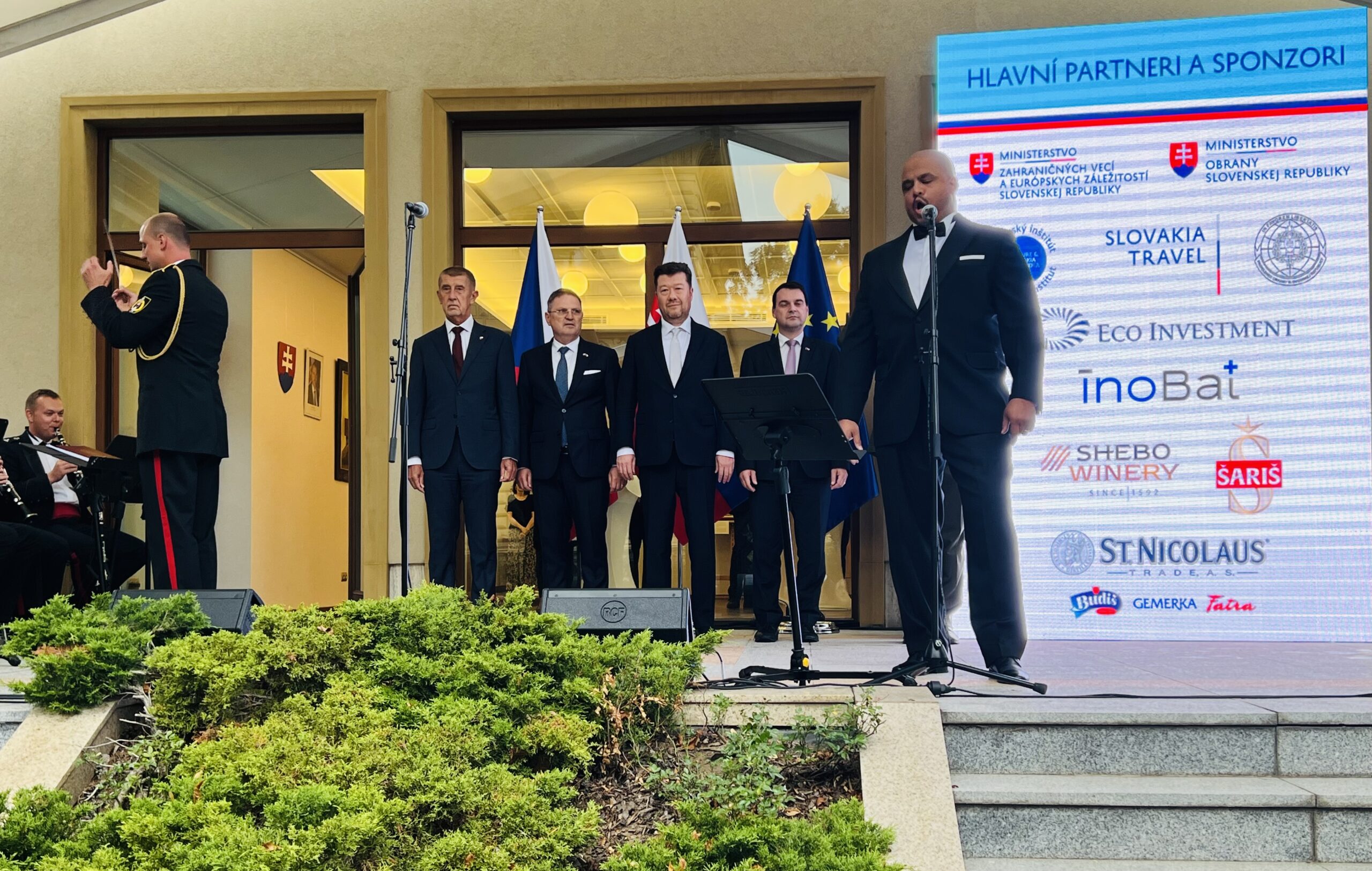
Petr Macinka and the two national anthems
Czech Foreign Minister and Deputy Prime Minister Petr Macinka chose a lighter historical observation.
At the beginning of the reception, the Czech and Slovak national anthems had been played.
Macinka recalled that the generations represented on the stage had grown up hearing them as two parts of the former Czechoslovak anthem: first Kde domov můj, then Nad Tatrou sa blýska.
Today, when Slovak representatives visit Prague, the order is simply reversed.
It was an amusing observation, but it carried a serious message.
Two states now exist where one once stood – but the melodies, memories and human connections remain.
Macinka also drew attention to something rarely noticed outside diplomatic circles: the Czech Embassy in Bratislava and Slovak Embassy in Prague are among their countries’ busiest diplomatic missions because the sheer volume of political, parliamentary, regional and municipal contacts between the two neighbours is extraordinary.
He publicly thanked Ambassador Muránsky for his work in maintaining those connections.
More than politics
The Prague reception demonstrated that Czech-Slovak relations are not maintained by governments alone.
Diplomats mixed with parliamentarians, senior officers, entrepreneurs, representatives of churches and cultural figures.
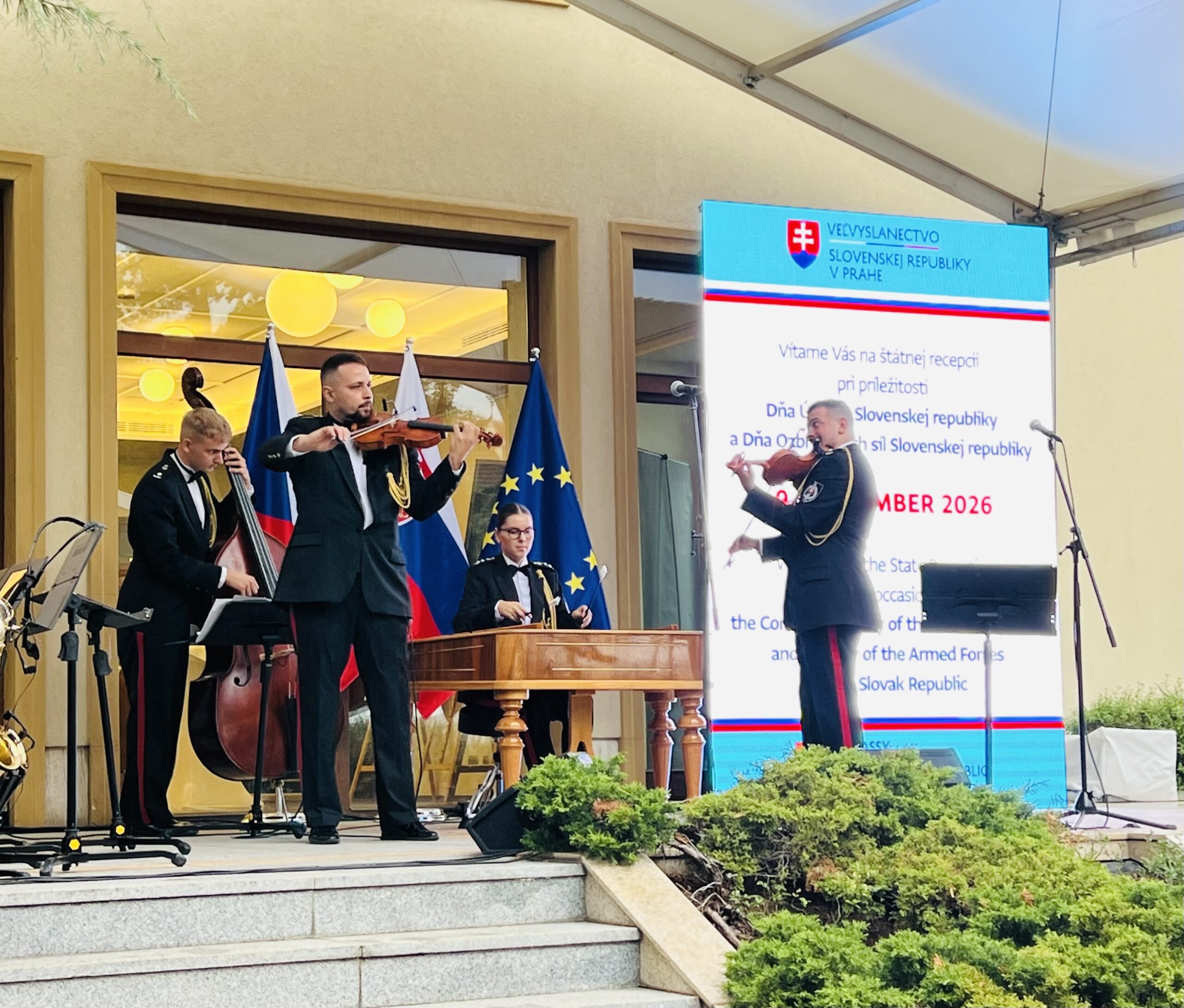
The programme also showcased Slovak culture, tourism and business. The Military Music Banská Bystrica performed under Major Ján Goliáš together with baritone Filip Bandžak. Slovak companies and tourism regions presented themselves, while the exhibition Oči plné obrazu connected contemporary Slovak art with the heritage of the Czech brothers Karel and Josef Čapek.
And, naturally, no Slovak reception would be complete without Slovak food and wine.
Guests were able to enjoy Slovak specialities accompanied by Slovak wines and beverages – an appropriately convivial conclusion to an evening devoted to friendship.
Even the weather cooperated. The threatened heavy rain largely stayed away, allowing the reception to retain the relaxed atmosphere traditionally associated with this annual gathering in Bubeneč.
Two states – one exceptionally close relationship
Czechs and Slovaks were never simply one indistinguishable people.
History is more interesting than that.
They were two closely related nations that developed for centuries under different political systems, came together at a moment of extraordinary European upheaval in 1918, lived through democracy, dictatorship, war, communism and revolution together – and eventually decided peacefully to continue separately.
What initially looked like the end of a state turned out not to be the end of a relationship.
More than three decades after the separation, Czechia and Slovakia remain independent countries with their own political debates, national interests and identities.
But very few neighboring countries in Europe share so much.
Languages remain mutually understood.
Families cross the border.
Students study on both sides.
Companies operate in both economies.
Politicians meet constantly.
The two societies still follow each other’s news, culture and sport with an intimacy that would be unusual between ordinary neighbors.
Perhaps that is the most important lesson of the Czechoslovak story.
A common state does not necessarily have to exist forever in order to have been successful.
And political separation does not necessarily have to create estrangement.
The Czech and Slovak experience shows that sovereignty and friendship can coexist.
On that September evening in Prague, this was not merely a historical theory.
It was visible among the hundreds of guests in the garden of the Slovak Embassy.
Two republics.
Two national anthems.
Two political systems.
But a history that remains shared – and a friendship that, more than a century after the creation of Czechoslovakia and more than three decades after its peaceful dissolution, remains quite exceptional.
All the best to Slovakia, to the Slovak Armed Forces and to the Slovak people – and all the best to the friendship between Slovaks and Czechs.
Recent posts
See AllPrague Forum Membership
Join us
Be part of building bridges and channels to engage all the international key voices and decision makers living in the Czech Republic.
Become a member